How We Work
Evidence-informed, systemic and tailored to context
CSA works with leaders, executive teams and organisations to address complex leadership and organisational challenges. We do not begin with a predetermined programme or methodology. We begin by understanding the organisation, its purpose and strategy, the people involved, the wider context and the outcomes the work needs to achieve. Our approach combines organisational psychology, evidence-based practice and more than three decades of consulting experience. It is also informed by a central principle: leadership and organisational effectiveness cannot be separated from the social and ecological systems in which organisations operate.1. Understand the context
Every engagement begins with context. We seek to understand the organisation’s purpose, strategy, operating environment, culture and current challenges, together with the wider stakeholder, social and environmental context in which it operates. This is particularly important where organisations are responding to complex challenges such as strategic transformation, climate change, biodiversity loss or changing stakeholder expectations. The same leadership behaviour or organisational intervention will not necessarily be effective in every context.2. Diagnose before intervening
CSA uses assessment and diagnosis to develop an evidence-based understanding of the issue before recommending action. Depending on the engagement, this may include executive interviews, psychometric assessment, 360-degree feedback, team diagnostics, organisational surveys, stakeholder interviews, document analysis and relevant organisational performance data. Assessment is not an end in itself. Its purpose is to identify the individual, team and organisational factors most likely to influence the desired outcomes.3. Integrate multiple sources of evidence
Our approach reflects the scientist-practitioner tradition of organisational psychology and contemporary evidence-based management. Rather than relying on a single model or source of information, we integrate research evidence, organisational data, stakeholder perspectives and professional expertise. This allows us to distinguish between established evidence, emerging practice and assumptions that still need to be tested.4. Design around the system
Leadership challenges rarely reside entirely within an individual. CSA therefore considers three interconnected levels: Executive Leadership, Executive Teams and Positive Organisations. An executive’s effectiveness is influenced by their strengths, behaviour and context. Their impact is mediated through the executive team. The team’s effectiveness is shaped by organisational culture, governance and systems. The organisation itself operates within wider social and ecological systems. Our interventions are designed around the level, or combination of levels, at which change is required.5. Build on strengths while addressing what needs to change
CSA pioneered strength-based approaches to leadership development, but strength-based does not mean focusing only on what is positive. We identify existing capabilities that can provide leverage for development while also addressing performance gaps, risks and behaviours that need to change. Strengths need to be aligned with role and purpose and used appropriately. They can be underused, overused or poorly matched to context. The objective is not simply to develop more capability, but to develop the right capability, applied in the right way, for the right purpose.6. Translate insight into behaviour and action
Assessment, feedback and insight have limited value unless they change what leaders, teams and organisations actually do. CSA therefore works with clients to translate diagnosis into clear priorities, behavioural objectives and practical action. Depending on the engagement, this may involve executive coaching, team coaching, facilitated development, leadership practice, governance processes or changes to organisational systems and culture. For sustainability work, the same principle applies. Climate and nature commitments become meaningful when they influence strategy, governance, leadership decisions, resource allocation and organisational behaviour.7. Measure, reflect and adapt
Wherever practicable, we establish meaningful outcomes at the beginning of an engagement and assess progress against them. Evaluation may include changes in leadership behaviour, multi-rater feedback, team effectiveness, stakeholder perceptions, organisational measures or progress against agreed strategic and sustainability outcomes. We also build reflection into the development process rather than assuming that an intervention that worked elsewhere will necessarily work in a particular organisation.| Understand → Diagnose → Design → Act → Measure → Reflect → Adapt |
Working in partnership
CSA seeks to build trusted, long-term relationships with clients. The better we understand an organisation’s strategy, people, culture and context, the more effectively we can contribute. We work collaboratively rather than imposing standardised solutions. Our role is to bring independent judgement, psychological expertise, research evidence and constructive challenge while recognising that clients bring essential knowledge of their organisation and operating environment.From organisational effectiveness to sustainable impact
Our definition of effectiveness has evolved. Organisational performance remains important, but organisations ultimately operate within society and the natural environment. We therefore consider not only whether an intervention improves individual, team or organisational effectiveness, but how leadership and organisational decisions contribute to wider social and environmental outcomes. This is particularly important as organisations respond to the interconnected climate and biodiversity crises. Our aim is to help clients build leadership capability and organisational systems that are effective, ethical, responsible and sustainable.Typical Leadership Development Interventions:
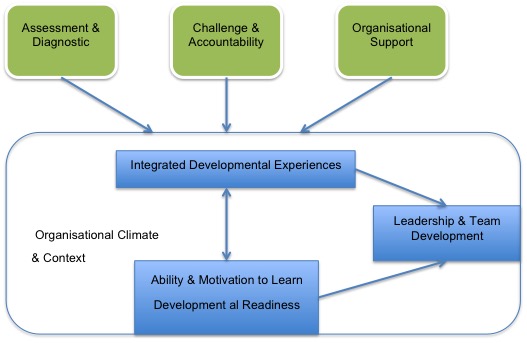
CSA uses the leadership and team development model outlined below as a template for designing leadership and team development interventions. Initially we would meet the individual participants and understand their strengths and challenges before collecting data on their leadership behaviours. This data is most commonly collected in the form of psychometrics, at both the individual and team level. For this engagement we would recommend the MLQ360, Hogan Personality Inventory and Realise 2 Inventory. The second key element of successful programs is assessing the readiness and capacity of individual team members for development and change. This is most commonly done in an individual 1:1 interview prior to any leadership or coaching process.