

Positive Leadership
Strength-based development is one of CSA Consulting’s most established areas of academic and professional expertise. Dr Doug MacKie’s work in this field extends from doctoral research and a controlled study of strength-based executive coaching, through a specialist book and subsequent chapters, to recent scholarship examining the evolution of strength-based leadership towards contextual, ethical and systemic impact.
This body of work provides the academic foundation for CSA’s approach to CEO and executive assessment, executive coaching, team development and sustainability leadership. The central proposition is more demanding than ‘identify your strengths and use them more’. Effective development requires evidence about distinctive capability, alignment with role and purpose, judgement about context, regulation of overuse and underuse, and the capacity to combine complementary strengths.
Strength-based approaches also sit within a much older intellectual tradition concerned with character, virtue and judgement. Contemporary leader-character research reconnects leadership development with Aristotelian practical wisdom, emphasising that apparently positive qualities can become dysfunctional when exercised without judgement or balancing virtues (Crossan et al., 2017; Crossan & Crossan, 2023). This provides an important corrective to simplistic assumptions that more of a strength is always better.
From strengths identification to leadership effectiveness
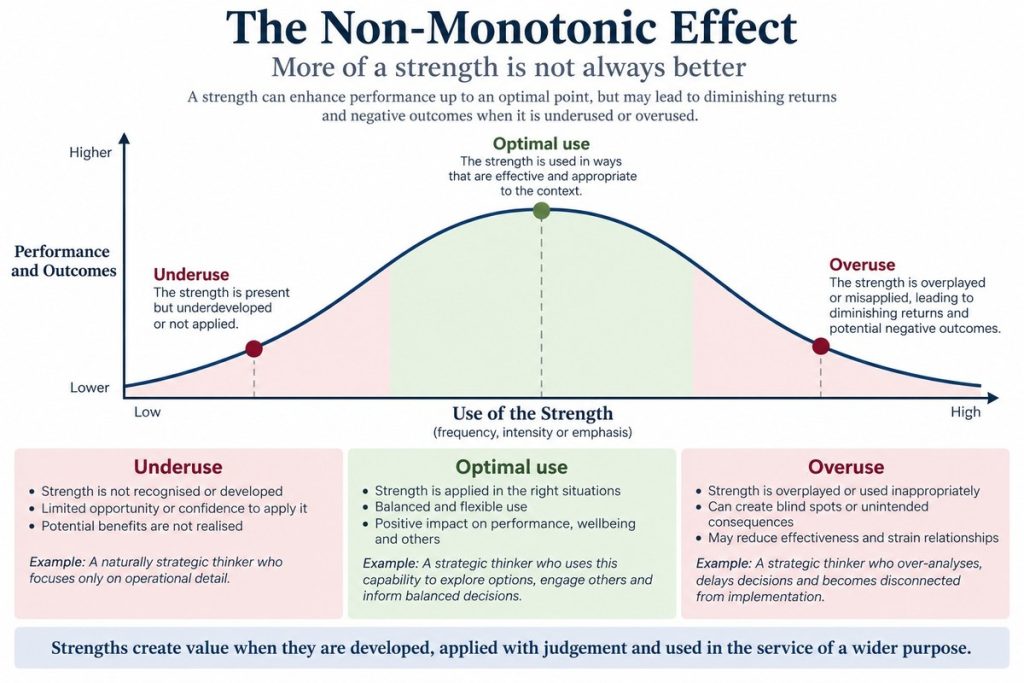
My early work challenged the assumption that positive leadership development should simply amplify what leaders already do well. Strengths can energise development, support engagement and contribute to goal attainment, but they can also produce lopsided leadership, derailment through overuse, avoidance of difficult conversations and insufficient attention to negative emotion. The relationship between strength use and performance can therefore be non-monotonic: more is not always better. This distinction matters because the relationship between strengths and performance is often non-linear – what are known as non-monotonic effects. A capability can be underused, appropriately used or overused, and a strength that is effective in one context can become ineffective when misapplied in another. The developmental task is therefore not simply amplification. It is the calibrated use of strengths in relation to role demands, organisational purpose, other people and context (Grant & Schwartz, 2011; MacKie, 2017, 2026).
Turning distinctive strengths into enhanced leadership effectiveness
Strength-based development is not simply a preferred coaching style at CSA. It is a field in which Dr Doug MacKie has undertaken doctoral research, conducted controlled organisational research, authored a specialist book and published across leadership development, team effectiveness and sustainability. His PsyD focused on strength-based leadership coaching, and this programme of work has progressively examined a central question: how can strengths be identified, developed and deployed so that they produce observable improvements in leadership effectiveness rather than merely positive self-perceptions?
A research programme, beyond the ‘identify and use’ approach
Early positive psychology helped correct the deficit orientation that had dominated much applied psychology, but its translation into leadership development was sometimes conceptually simplistic. Identifying a person’s strongest qualities does not establish that greater use of those qualities will necessarily improve performance. MacKie’s reviews of positive leadership development argued for greater precision in the definition, assessment and development of strengths and for outcomes that extend beyond self-report (MacKie, 2017).
This distinction matters because the relationship between strengths and performance is often non-linear – what are known as non-monotonic effects. A capability can be underused, appropriately used or overused, and a strength that is effective in one context can become ineffective when misapplied in another. The developmental task is therefore not simply amplification. It is the calibrated use of strengths in relation to role demands, organisational purpose, other people and context (Grant & Schwartz, 2011; MacKie, 2017, 2026).
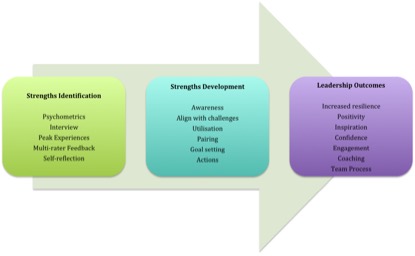
The model deliberately moves beyond strengths identification. It treats strengths as resources whose value is realised through alignment, contextual judgement and coordinated application. This provides the conceptual foundation for CSA’s CEO and Executive Assessment, Executive Coaching, Team Leadership and Team Coaching services.
Empirical evidence of significant leadership change
MacKie’s controlled organisational study of 37 executives and senior managers tested a manualised strength-based executive coaching protocol using repeated 360-degree assessment of full-range leadership. Participants received six coaching sessions over three months, incorporating leadership and strengths feedback, goal setting and strengths development. The study found highly statistically significant increases in transformational leadership following coaching. Importantly, the change was reported by organisational raters at multiple levels rather than by the participants themselves. Adherence to the strength-based protocol also significantly predicted the degree of leadership change (MacKie, 2014).
The significance for CSA is methodological as well as practical. The research tested a specified development process against observable leadership outcomes rather than relying on participant satisfaction or generic claims about coaching. The study does not establish that strength-based coaching is superior to every alternative methodology, but it provides direct evidence that a structured strength-based protocol can enhance externally observed leadership behaviour (MacKie, 2014).
The evolution towards contextual and systemic strengths
More recent scholarship in the strength-based approach has progressively widened the purpose of strength-based development, describing three broad waves in the evolution of strength-based leadership, (MacKie, 2026). The first emphasised positive traits and states; the second incorporated balance, meaning, context and the risks of excessive strengths use; and the third foregrounds situational, ethical and planetary concerns. Strengths are consequently assessed not only for individual efficacy but also for their impact on teams, organisations and wider systems.
This development also connects strength-based leadership with sustainability. Our research on strength-based coaching and sustainability leadership argues that development undertaken in a value-neutral context can privilege individual agency and self-enhancement while neglecting social and environmental consequences. A more mature strength-based approach asks not only ‘What am I good at?’ but ‘To what purpose should these strengths be applied, for whose benefit, and with what wider impact?’ (MacKie, 2021, 2026).
From executives to teams and sustainability
Doug’s later publications extended strength-based development into team leadership and sustainability leadership (MacKie, 2020, 2021). This reflects a broader CSA proposition: strengths create greatest value when aligned with collective purpose, paired with complementary capabilities and applied with judgement to consequential organisational and societal challenges.
The evolution of strength-based leadership
MacKie’s 2026 entry on Strength-Based Leadership in The Palgrave Encyclopedia of Leadership and Organizational Change places strength-based leadership within three developmental waves of positive psychology. The first wave emphasised identifying and amplifying positive traits and states. The second introduced greater balance through attention to meaning, negative emotion, context and the non-monotonic effects of strengths, recognising that strengths can be underused as well as overused. The emerging third wave broadens the unit and purpose of analysis further, foregrounding situational, ethical, organisational and planetary considerations (MacKie, 2026).
This evolution is central to CSA’s approach. Strengths are not treated as inherently beneficial qualities to be maximised irrespective of context. Their value depends on how, when and for what purpose they are deployed. Strength-based leadership therefore progresses from individual efficacy towards team, organisational and systemic impact, with increasing attention to self-transcendence, sustainability and the wider social and ecological consequences of leadership (MacKie, 2026).
From individual strengths to systemic impact
The 2026 analysis also strengthens the conceptual link between CSA’s established strength-based development work and its later focus on teams and sustainability. It argues that strengths increasingly need to be understood within collective and systemic contexts. At team level, strengths use can support task allocation, collaboration and team performance. At the wider system level, the question becomes not only whether a strength enhances individual or organisational performance, but whether its use contributes to ethical, prosocial and environmentally sustainable outcomes (MacKie, 2026).
Strength-based Approaches
There is no agreed standardised protocol for strength based coaching. However there have been several attempts to articulate the assumptions that predicate this approach, (Linley, 2008). In essence it focuses on:
1. Focus on what’s right, working and strong
2. Recognises strengths as part of basic human nature
3. Believes the areas of greatest potential are our strengths
4. Believes we succeed by addressing our weaknesses only when we are also making the most of our strengths.
5. Believes using our strengths is the smallest thing we can do to make the biggest difference
6. Believes that strengths can be over, under or misused.
Academic foundation for CSA services
|
This expertise directly underpins: CEO & Executive Assessment – identifying capability in relation to role, context and future demands rather than producing a generic strengths profile. CEO & Executive Coaching – translating strengths awareness into aligned, regulated and observable leadership behaviour. Team Leadership & Team Coaching – coordinating complementary strengths so that individual capability becomes collective capacity. Sustainability Leadership – directing leadership capability towards self-transcendent, responsible and sustainable organisational outcomes. |
Selected References
- Crossan, M. M., Byrne, A., Seijts, G. H., Reno, M., Monzani, L., & Gandz, J. (2017). Toward a framework of leader character in organizations. Journal of Management Studies, 54(7), 986-1018.
- Crossan, C., & Crossan, M. (2023). The practice of developing leader character to elevate judgment. In T. P. Newstead & R. E. Riggio (Eds.), Leadership and Virtues: Understanding and Practicing Good Leadership. Routledge.
- MacKie, D. J. (2014). The effectiveness of strength-based executive coaching in enhancing full range leadership development: A controlled study. Consulting Psychology Journal: Practice and Research, 66(2), 118-137.
- MacKie, D. J. (2016). Strength-Based Leadership Coaching in Organizations: An Evidence-Based Guide to Positive Leadership Development. Kogan Page.
- MacKie, D. J. (2020). A strength-based approach to developing team leadership and effectiveness. In D. Clutterbuck, C. Murphy, & T. Turner (Eds.), The Team Coaching Casebook. Oxford University Press.