

Research & Evidence
Where science and practice meet
CSA Consulting was founded on the scientist-practitioner model of organisational psychology: the proposition that effective professional practice should both draw upon scientific evidence and contribute to its development. For CSA, research is therefore not separate from consulting practice. It provides a means of questioning assumptions, testing methodologies, evaluating outcomes and continually refining how we work with leaders, teams and organisations. Our approach is consistent with evidence-based management, which integrates the best available research with organisational evidence, stakeholder perspectives and informed professional judgement.| Research informs practice. Practice tests research. Evidence improves both. |
From research to practice, and practice to research
CSA’s research has developed through the practical challenges encountered in client work. Questions arising from executive assessment, coaching, leadership development and team effectiveness have been translated into research questions, investigated systematically and then used to refine subsequent practice. This creates a continuing cycle of research, application, measurement, reflection and refinement. Client work becomes the crucible in which established knowledge is tested and professional expertise is redeveloped.A sustained programme of leadership research
Strength-Based Leadership
Doug MacKie’s doctoral research and subsequent publications examined how strengths can be translated into observable leadership development rather than simply positive self-perceptions. This work progressed from strengths identification towards alignment, utilisation, strengths overuse and underuse, team strengths, sustainability and the systemic application of strengths.Executive Coaching & Transformational Leadership
MacKie’s 2014 controlled study addressed three persistent weaknesses in coaching research: inconsistent intervention methodologies, poorly specified outcomes and over-reliance on participant self-report. The study involved 37 executives and senior managers, a manualised strength-based coaching methodology, 11 coaches and repeated multi-rater assessment of transformational leadership.Team Leadership & Coaching
Later research extended the unit of analysis from the individual leader to the executive team, examining shared and distributed leadership, strength-based team development, team coaching and the translation of individual expertise into collective capability.Sustainability & Climate Change Leadership
More recent work extends leadership development beyond individual and organisational effectiveness towards responsible leadership, sustainability and the organisational capabilities required to respond to the climate and biodiversity crises.The Scientist-Practitioner Model
We are passionate about adopting the scientist-practitioner model, practising business psychology in an evidence-based manner and operationalising the latest leadership research for our clients. We are pioneers of the strength-based approach to leadership development and have published on impacts on transformational leadership, developmental readiness, levels of organisational impact, ROI, team coaching and leadership coaching within the last year.
This approach brings a rigour, structure and innovation to our practice. We constantly question how to add value to clients, refine our practices, assess the return on investment and innovate new solutions to the challenges clients face. We are committed to our own professional development and to that end publish, write, present and advise in the areas of global leadership, transformational leadership, strength-based approaches, talent identification & assessment, positive leadership development and high-performing teams.
We have built a solid academic base that supports our innovative practice and to this end have been appointed to a number of editorial journal roles, the practice editor role for Coaching: An international journal of theory, research and practice as well as publishing multiple papers in the area of leadership, team development, program effectiveness and sustainability.
This approach brings a rigour, structure and innovation to our practice. We constantly question how to add value to clients, refine our practices, assess the return on investment and innovate new solutions to the challenges clients face. We are committed to our own professional development and to that end publish, write, present and advise in the areas of global leadership, transformational leadership, strength-based approaches, talent identification & assessment, positive leadership development and high-performing teams.
We have built a solid academic base that supports our innovative practice and to this end have been appointed to a number of editorial journal roles, the practice editor role for Coaching: An international journal of theory, research and practice as well as publishing multiple papers in the area of leadership, team development, program effectiveness and sustainability.
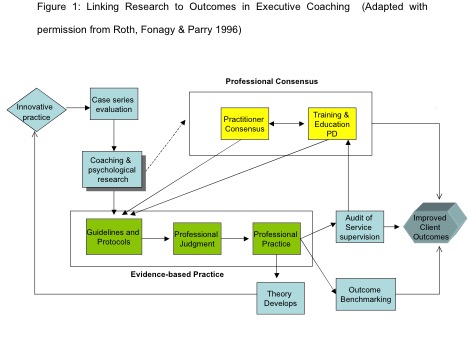
Case Study: How does research help practice?
In 2011 we established a research program to address some of the major challenges in coaching research: 1. Methodological inconsistency – that is practitioners may define themselves as solution-focused but we really don’t know what they do in session 2. Heterogeneity of outcomes – the absence of defined outcome parameters that relate to performance and 3. The over-reliance on self-report data – the majority of outcome studies rely on subjective reports of enhanced well-being etc. but are these changes noticed by anyone else in the organisation and what’s the impact for the organisational objectives? To address these issues I set up a waitlist controlled design with the top two layers of the local arm of a multi-national NFP organisation (N=37). I used transformational leadership as the dependent variable, recruited an average of 10 raters per participant and developed a strength-based methodology which was manualised to encourage consistency of delivery amongst the 11 coaches involved. The results were unequivocal – very significant changes between the waitlist and control groups after strength-based coaching on transformational leadership and crucially these differences were perceived at all levels in the organisation. In addition manual adherence was strongly predictive of ultimate change in transformational leadership suggesting the strength-based methodology was a significant factor. Finally the study delivered a very positive ROI (825%) for the organisation in a time of significant difficulty which was highly commercially and strategically significant.