Business Psychology @ Work I CART


Feel free to call us: +61 7 3010 9735
Climate change leadership is based on three increasingly incontestable premises. Firstly, that a significant proportion of global warming and biospheric degradation is anthropogenic in attribution. Secondly, that organisations and corporations are responsible for a substantial component of the adverse impacts of climate change through their products, processes and purchasing. Thirdly that the leadership of those corporations and organisations have failed in their responsibility to mitigate the environmental and unsustainable damage that their organisations continue to inflict on multiple planetary boundaries. The abject failure of contemporary leadership to address one the major existential threats to humanity has created by necessity, the opportunity for new models of leadership to emerge and flourish. There is now unequivocal that modern affluent high-consumption societies are over-utilising natural resources resulting in a climate and biodiversity catastrophe, (IPBES, 2019). On a variety of metrics, the material footprint of humanity has and continues to significant exceed the carrying capacity of the natural environment (UN, 2017). Only 17% of the sustainable development goals (SDG’s) are on track, (UNDESA, 2024) and six of the nine planetary boundaries have already been breached, (Richardson et al, 2023). Clearly the promotion of and transition to a more responsible and sustainable footprint especially in high income countries is paramount and organisations and their leadership play a critical role in augmenting this transformation, (MacKie, 2023).
Key Concepts & Models
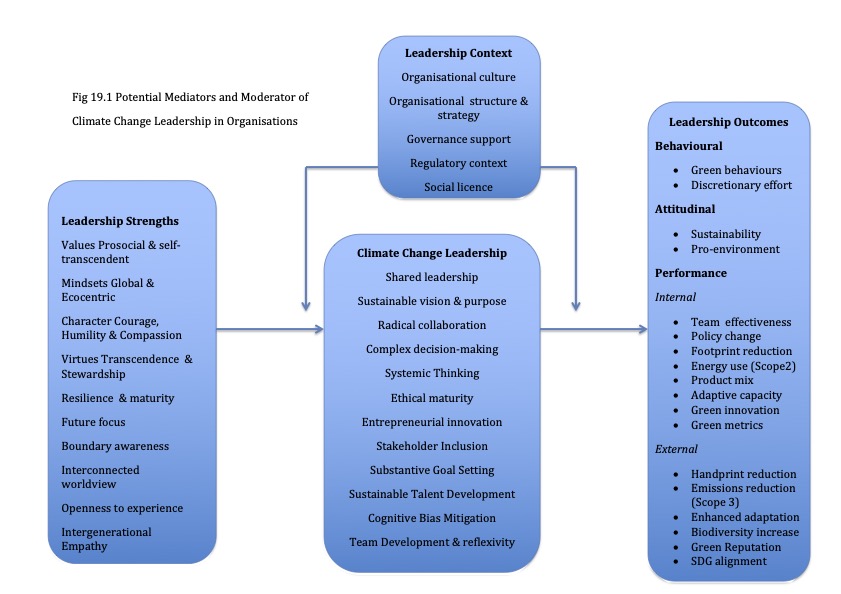
Post-conventional leadership including climate change leadership is complex, emerging and contested. There have been various attempts to impose some structure and order on the field including definitions of post-conventions models, (Schein, 2015), descriptions of post-conventional competencies (Ross et al, 2022) and attempts to categorise the transition from conventional to post-conventional, (MacKie, 2023). This latter model included delineating the stages into foundations, transitions, progressions and actions.
The foundations of climate change leadership include virtues, values, mindsets and character, (MacKie, 2023). Values affect leadership behaviour through both cognition and emotions which signal they have been affronted through the activation of positive or negative affect, (Steg, 2023). Values tend to form early in life via a complex interplay of cultural and experiential factors, (Feather, 1995). Once formed, they appear relatively stable over time and are one of the implicit factors that shape the future interpretation of events and experiences. One of the critical distinctions in the research of values is between self-enhancing and self-transcending values, (Schwartz, 1940). There is converging evidence that climate change leaders endorse more self-transcending values including universalism and benevolence, (Lombardo et al, 2013). Furthermore, there is evidence that pro-environmental values are better not just for planetary impact but also for mental health and well-being too, (Kasser, 2016). Those who adopt more materialistic and self-enhancing values pay a significant price in terms of both their individual mental health and their adverse impact on the planet, (Isham et al, 2023).
Transitions refers to conventional models of leadership that are being repurposed for the age of sustainability, (MacKie, 2023). Transformational leadership is the archetypal example of a transitional model with the repurposing of what was originally an individually focused and environmentally agnostic approach to its metamorphosis into environmentally specific transformational leadership, (ETFL). ETFL integrates environmental and planetary concerns into the original model and this predicts subsequent pro-environmental behaviour and green creativity, (Karamally & Robertson, 2023). Other significant models included in the transition phase include ethical and responsible leadership. Ethical leadership has recently been extended beyond consequentialist and virtue-based decision-making to include bioethics and stewardship, (Brown & McManus, 2023). Finally responsible leadership has been extended to be far more inclusive in stakeholder analysis so that the environment, biosphere and future generations can be included in decision-making, (Muff et al, 2020). Place-based approaches are the latest iteration of the transition of responsible leadership to include environmental concerns, (Kempster & Jackson, 2021).
Progressions is focused on the innovative and emergent models of leadership that are directly targeted towards addressing complex and wicked problems like climate change. These include theories of adult development that map the maturational ontogeny of the individual leader through various stages from instrumental to self-transforming, (Kegan & Lahey, 2010). Other models of maturity have promoted a competency rather than stage orientated approach with humility, perspective taking, curiosity and reflexivity nominated as essential post-conventional capabilities, (Cannon et al, 2015). Higher stages of adult development have indeed been found to be positively correlated with increased corporate concerns for the environment, (Boiral et al, 2018). Finally, systems leadership is another concept that is emerging in the post-conventional paradigm with its explicit focus on interconnectedness and intergenerational empathy, (Senge et al, 2015).
In the final category, actions address the issues of sustainable goal setting, corporate carbon targets and the coaching and development of climate change leaders. Critical factors in sustainable goal-setting includes the concept of double materiality whereby organisations measure not only the risk that climate change presents to their organisation but also the risk that the organisation presents to the climate, (Eubank, 2023). Carbon targets have also received significant attention with the type, scope, ambition and timeframe of the organisation’s carbon aspirations being assessed, (Dahlman, 2023). Additionally structures like net-zero and science-based targets offer external benchmarks for transcendent and sustainable goal setting. However, goals like net-zero are not without controversy as many of the offsets utilised are of dubious quality and can present a moral hazard in terms of delaying the essential reduction in absolute emissions, (Rayner, 2024) These elements with their focus on targets, policy and governance sit firmly in the outer-development domain but must be complimented by equal focus on the inner development of the climate change leader, (MacKie, 2023). Traditional leadership pedagogies and developmental processes are now being adapted and repurposed for the age of sustainability, (Hoffman, 2025; DiGirolamo, 2023).