

Team Effectiveness & Leadership
How executive teams convert individual expertise into collective leadership
A substantial area of CSA expertise
Teams are not an extension of CSA’s individual coaching work. They constitute a substantial area of research, publication and practice in their own right. Doug co-edited The Practitioner’s Handbook of Team Coaching and has published specifically on shared leadership, team coaching and strength-based approaches to team leadership and effectiveness (MacKie, 2019, 2020).
Executive teams are leadership systems
An executive team is not simply a collection of high-performing individuals. Research on team effectiveness has consistently shown the importance of enabling conditions, including team design, compelling direction, supportive context and coaching (Hackman, 2002). Effectiveness also depends on the quality of team processes and the team’s capacity to mobilise leadership collectively. CSA therefore examines purpose, composition, structure, relationships, decision-making, coordination, leadership and organisational context as an interconnected system.
Balancing hierarchical and distributed leadership
Doug’s published work on shared leadership and team coaching examines how leadership can be distributed across a team without assuming that formal hierarchy should be retired. Balancing hierarchical and distributed forms of leadership is one of the essential tensions of high-performing executive teams. Formal leadership provides direction, accountability and decision authority, while distributed leadership allows expertise, influence and initiative to be mobilised across members.
This position is consistent with meta-analytic evidence. Wang, Waldman and Zhang (2014), drawing on 42 independent samples, found a positive association between shared leadership and team effectiveness and evidence that shared leadership contributed uniquely beyond vertical leadership, particularly in more complex work.
Strengths as collective capability
CSA extends strength-based development from the individual to the team. Members need to understand the strengths available across the group, align them with shared priorities, utilise them appropriately and pair complementary capabilities. The emphasis therefore shifts from the effectiveness of individual executives towards the leadership capacity of the team as a whole.
The bridge between CEO and organisational effectiveness
CSA views the executive team as the critical meso-level bridge between individual CEO effectiveness and wider organisational performance. Strategy, culture, transformation and sustainability are rarely delivered by a CEO acting alone. They depend on the executive team’s capacity to lead collectively and mobilise leadership throughout the organisation.
The core proposition is that an executive team is not simply a collection of individually effective executives. Team effectiveness is produced by a system of conditions, processes and leadership relationships that enables members to integrate expertise, exercise mutual influence and lead beyond their functional boundaries.
An integrated model of team effectiveness
CSA draws together three complementary perspectives. Hackman’s work focuses attention on team readiness and structural conditions: whether there is a real team, the right people, a compelling direction, a sound structure and a supportive context. Hawkins’ systemic team coaching model focuses on process across the team’s internal and external boundaries. Team effectiveness is then judged through outcomes at three levels: whether results meet expectations (‘It’), whether the team increases its collective capacity (‘We’), and whether individual members develop and learn (‘I’).
| CSA integrated team framework
TEAM READINESS → TEAM PROCESS → LEADERSHIP → TEAM OUTCOMES |
Team Effectiveness Research
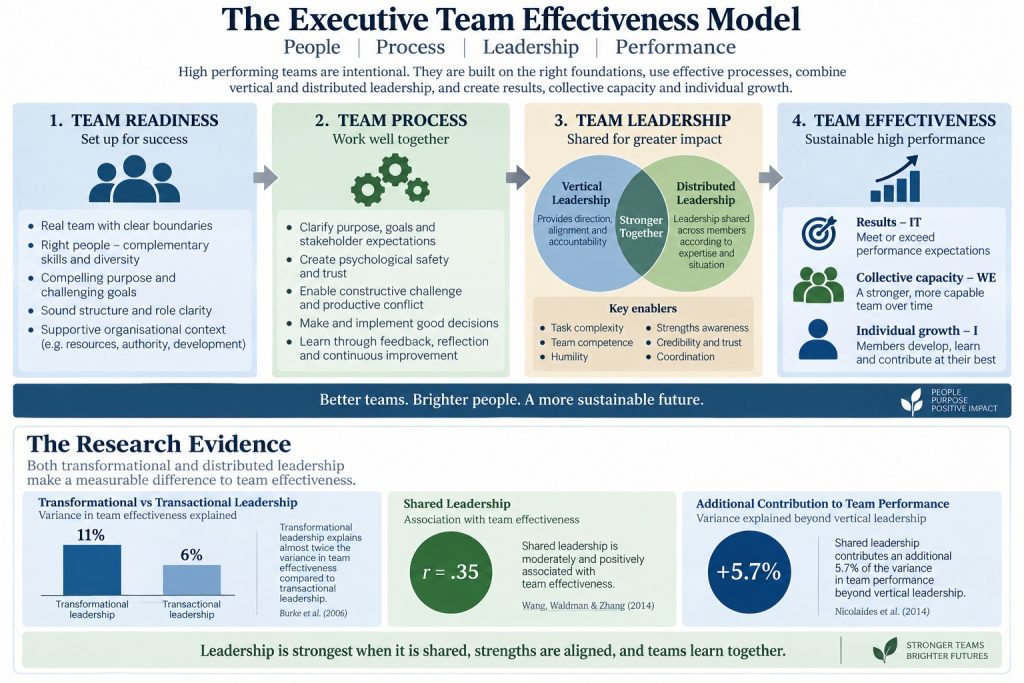
Transformational leadership is one important part of that picture. Burke et al.’s (2006) meta-analysis found that transformational leadership accounted for approximately 11% of the variance in team effectiveness, compared with approximately 6% for transactional leadership. This is a meaningful difference, but it also demonstrates that leadership style alone explains only part of team performance.
The shared leadership evidence strengthens the case for treating leadership as a team-level phenomenon. Meta-analytic research reports a correlation of approximately .35 between shared leadership and team effectiveness. Nicolaides et al. (2014), drawing on 54 studies and 3,882 teams, found that shared leadership explained an additional 5.7% of variance in team performance beyond vertical leadership. The effect is conditional rather than universal. Important moderators include task complexity, member competence, leader humility and the team’s capacity to recognise, trust and coordinate expertise.
Key Processes in Team Development – Strengths and Reflexivity
Strengths as a mechanism for distributed leadership
MacKie’s strength-based team work provides a mechanism through which distributed leadership can operate. Strengths can contribute to team performance through three linked processes: collective awareness of the variety of strengths available in the team; credibility, reliance and trust in those strengths when executing team tasks; and coordination of work and allocation of roles around relevant capability. In shorthand, collective strength use requires awareness, credibility and coordination.
This relationship is also context dependent. Strength diversity, the presence of a strength-based climate and task complexity can alter whether individual capability translates into collective performance. The implication is important for executive teams: simply mapping strengths is insufficient. The team has to develop confidence in each other’s capabilities and deliberately coordinate them around interdependent work.
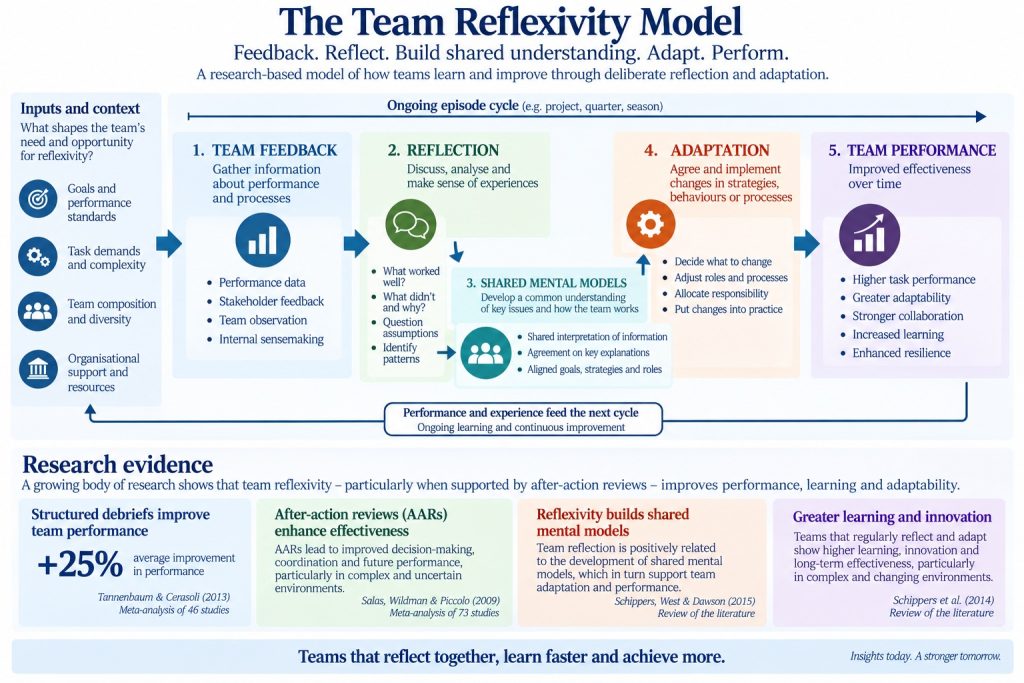
Team reflexivity and learning
High-performing teams also need the capacity to examine and adapt their own processes. This is the basis for CSA’s use of process checks, learning reviews and after-action reflection. Tannenbaum and Cerasoli’s (2013) meta-analysis of 46 studies found that properly conducted debriefs were associated with approximately a 20-25% improvement in performance. Reflexivity therefore becomes a practical team capability: teams improve not only by working harder, but by systematically examining how they are working and adjusting in real time.
From Research to Practice
Research translated into executive team practice
CSA’s team methodology uses this evidence to connect assessment with development. Team readiness can be examined structurally. Team process can be assessed through the Five Cs of commissioning, clarifying, co-creating, connecting and core learning. Transformational team leadership can be assessed through stakeholder perspectives on whether the team builds trust, acts with integrity, inspires, encourages innovation and coaches and develops its members. This moves team development beyond internal perceptions and makes stakeholder impact part of the evidence.
MacKie’s published strength-based team coaching case study illustrates this approach. It combined individual strengths interviews, 360-degree leadership feedback, team diagnostic data, a team development workshop and subsequent team coaching, with team leadership assessed by multiple stakeholder groups. Following the intervention, several transformational leadership dimensions improved significantly, as did ratings of team effectiveness and satisfaction with team leadership. The strongest supplementary change concerned the team’s use of the collective strengths of its members. As an uncontrolled case study it does not establish causality, but it demonstrates a theoretically coherent, multi-source methodology for evaluating team development.
From research to CSA’s Executive Team services
This body of evidence provides the foundation for CSA’s four connected Executive Team services. Team Readiness addresses the conditions that make effective teamwork possible. Team Process addresses how the team works across task, relationship and stakeholder boundaries. Team Leadership develops the balance between formal leadership and distributed influence. Team Coaching integrates diagnosis, feedback, strengths, reflexivity and stakeholder evidence into a sustained development process.
Selected references
MacKie, D. (2019). Models of shared leadership and team coaching. In D. Clutterbuck et al. (Eds.), The Practitioner’s Handbook of Team Coaching. Routledge.
MacKie, D. (2020). A strength-based approach to developing team leadership and effectiveness. In The Team Coaching Casebook. Oxford University Press.
Anderson, C., & Brown, C. E. (2010). The functions and dysfunctions of hierarchy. Research in Organizational Behavior, 30, 55-89.
Burke, C. S., et al. (2006). What type of leadership behaviors are functional in teams? A meta-analysis. The Leadership Quarterly, 17, 288-307.
Nicolaides, V. C., et al. (2014). The shared leadership of teams: A meta-analysis of proximal, distal, and moderating relationships. The Leadership Quarterly, 25(5), 923-942.
Wang, D., Waldman, D. A., & Zhang, Z. (2014). A meta-analysis of shared leadership and team effectiveness. Journal of Applied Psychology, 99, 181-198.
Tannenbaum, S. I., & Cerasoli, C. P. (2013). Do team and individual debriefs enhance performance? A meta-analysis. Human Factors, 55(1), 231-245.