

Climate Advisory
Climate change is no longer simply an environmental or reporting issue. It is a strategic, governance and leadership challenge that requires organisations to understand both their exposure to a rapidly changing world and their own impact on the ecological systems on which long-term prosperity depends. CSA’s Climate Advisory practice works with Boards, CEOs and executive teams to strengthen the leadership and organisational capability required to navigate this transition. Our approach combines organisational psychology, leadership development, team effectiveness and contemporary climate governance with an established body of research and thought leadership in sustainability and climate change leadership.
Beyond compliance towards stronger sustainability
CSA understands the rapidly evolving climate governance and regulatory environment, but our Climate Advisory work is not primarily focused on helping organisations meet minimum compliance requirements. Compliance is necessary, but it does not by itself create a sustainable organisation. Our focus is on helping Boards, CEOs and executive teams understand where their organisation currently sits on the sustainability continuum and what leadership, team and organisational changes are required to move further along it. Our research distinguishes weaker approaches to sustainability, characterised by compliance, incremental improvement and the management of environmental impacts, from stronger approaches that progressively embed ecological limits, long-term stewardship and positive impact within organisational purpose, strategy, culture and governance. The objective is therefore to move beyond climate reporting towards organisational transformation. This may involve strengthening climate leadership capability at the individual level, aligning the executive team around a more ambitious sustainability agenda, and ensuring that organisational purpose, strategy, culture and governance support rather than inhibit that transition.
CSA helps organisations move beyond climate compliance towards stronger sustainability by developing the leadership capability, executive team effectiveness and organisational conditions required to make that transition.
A distinctive combination of leadership, psychology and sustainability
CSA’s Climate Advisory work is grounded in a distinctive combination of expertise. Dr Doug MacKie brings more than 30 years’ experience as an organisational psychologist, leadership expert, executive coach and adviser to CEOs, Boards and executive teams, together with an extensive research and publication record in leadership, team effectiveness and sustainability. Doug is editor of the Handbook of Climate Change Leadership in Organisations and has published a growing body of research, articles and book chapters on climate change leadership, sustainability leadership, executive coaching and team effectiveness. This thought leadership provides a research-informed foundation for helping organisations understand not only why the sustainability transition matters, but the leadership capabilities and organisational conditions required to achieve it.
This matters because climate transition is fundamentally an organisational challenge. Setting targets and developing policies are only part of the task. Aligning leaders, teams, culture, governance and organisational systems behind those ambitions is much harder. CSA brings deep expertise in how leaders and teams actually function, how organisations change, and how leadership capability can be translated into sustained action.
The CSA approach to Climate Advisory
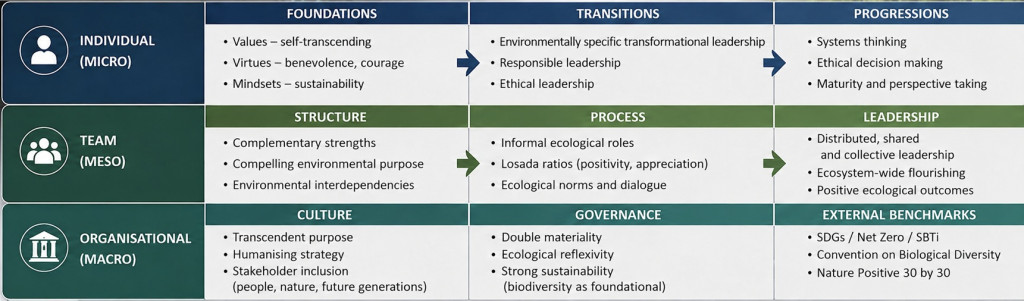
One integrated approach across three levels
One of the distinctive features of CSA’s approach is continuity across three interconnected levels of organisational effectiveness. Rather than treating leadership development, team effectiveness and organisational sustainability as separate interventions, CSA applies a coherent framework across the whole leadership system.
Individual – Executive leaders
Developing the judgement, systems thinking, values, resilience and leadership capability required to address complex climate and sustainability challenges.
Team – Executive leadership teams
Strengthening team structure, alignment, decision-making, distributed leadership and the collective capability required to turn sustainability ambition into coordinated action.
Organisation – Systems, culture and governance
Embedding climate and sustainability into organisational purpose, strategy, culture, governance and decision-making so that progress does not depend on the commitment of individual leaders alone.
Continuity that individualised advisory models can lack
Many climate advisory engagements focus primarily on strategy, reporting, risk or technical expertise. Leadership development providers, by contrast, often concentrate on the individual executive. CSA connects these domains.
The same underlying approach can be applied from the coaching and development of an individual CEO, through the alignment and development of the executive leadership team, to the organisational systems, culture and governance required to support climate transition. This continuity reduces fragmentation and helps ensure that leadership development, team effectiveness and organisational change reinforce one another. Technical climate advisers can provide essential expertise on emissions, disclosure, regulation and transition pathways. CSA complements this work by addressing the leadership and organisational question: how do we build the capability to turn climate ambition and technical strategy into sustained organisational action?
What are the benefits of Climate Advisory?
- Sustainability maturity – assessing where the organisation currently sits on the sustainability continuum and identifying the leadership and organisational changes required to progress towards stronger sustainability.
- Board climate governance – strengthening Board climate literacy, governance capability, decision-making and oversight of climate-related risks, opportunities and organisational impact.
- Climate leadership capability – assessing and developing leaders’ capacity to work with complexity, uncertainty, competing stakeholder expectations and long-term systemic challenges.
- Executive team alignment – helping leadership teams integrate climate and sustainability across strategy, operations, people, procurement and investment rather than allowing responsibility to remain within organisational silos.
- Purpose and strategy – helping organisations connect purpose, strategy and long-term value creation with sustainable prosperity and positive impact.
- Climate transition and organisational change – supporting the leaders and teams responsible for decarbonisation, electrification, sustainable procurement and broader organisational transition.
- Climate and nature integration – broadening the sustainability conversation beyond carbon to consider biodiversity, ecological dependency and the nature-positive agenda.
From Sustainability to Sustainable Prosperity
This requires moving beyond narrow shareholder primacy towards organisations that create positive economic, social and environmental value. The ambition is to help organisations progress from reducing harm towards stronger forms of sustainability in which long-term prosperity is increasingly aligned with the health of the social and ecological systems on which business ultimately depends.
Climate Advisory therefore asks a broader question: how can the organisation continue to prosper while contributing positively to the social and ecological systems on which that prosperity ultimately depends?
Axelsson, K., Wagner, A., Johnstone, I., Allen, M., Caldecott, B., Eyre, N., Fankhauser, S., Hale, T., Hepburn, C., Hickey, C., Khosla, R., Lezak, S., Mitchell-Larson, E., Malhi, Y., Seddon, N., Smith, A. and Smith, S.M. (2024) Oxford Principles for Net Zero Aligned Carbon Offsetting (revised 2024). Oxford: Smith School of Enterprise and the Environment, University of Oxford.
Chubb, I., Bennett, A., Gorring, A. and Hatfield-Dodds, S. (2022) Independent Review of Australian Carbon Credit Units: Final Report. Canberra: Australian Government, Department of Climate Change, Energy, the Environment and Water.
Intergovernmental Panel on Climate Change (IPCC) (2022) Climate Change 2022: Mitigation of Climate Change. Contribution of Working Group III to the Sixth Assessment Report of the Intergovernmental Panel on Climate Change. Cambridge: Cambridge University Press.
Johnstone, I., Allen, M., Axelsson, K., Caldecott, B., Eyre, N., Fankhauser, S., Hale, T., Hepburn, C., Hickey, C., Jenkins, S., Khosla, R., Lezak, S., Smith, A., Smith, S.M. and Wagner, A. (2025) ‘The revised Oxford principles for net zero aligned carbon offsetting’, Environmental Research Letters, 20(9), 091005.
Macintosh, A., Butler, D., Evans, M.C., Ansell, D. and Waschka, M. (2022) Fixing the Integrity Problems with Australia’s Carbon Market. Canberra: Australian National University.
MacKie, D.J. (ed.) (2023) The Handbook of Climate Change Leadership in Organisations: Developing Leadership for the Age of Sustainability. Abingdon: Routledge.
MacKie, D.J. (2023) ‘An introduction to climate change leadership in organisations’, in MacKie, D.J. (ed.) The Handbook of Climate Change Leadership in Organisations: Developing Leadership for the Age of Sustainability. Abingdon: Routledge, pp. 1-18. doi:10.4324/9781003343011-1.
MacKie, D.J. (2023) ‘Developing climate change leadership in organisations’, in MacKie, D.J. (ed.) The Handbook of Climate Change Leadership in Organisations: Developing Leadership for the Age of Sustainability. Abingdon: Routledge, pp. 385-405. doi:10.4324/9781003343011-23.
Seddon, N., Smith, A., Smith, P., Key, I., Chausson, A., Girardin, C., House, J., Srivastava, S. and Turner, B. (2021) ‘Getting the message right on nature-based solutions to climate change’, Global Change Biology, 27(8), pp. 1518-1546.