

Team Readiness
Is your team designed to succeed?
Not every collection of talented executives constitutes an effective team. Before investing heavily in team development or coaching, it is important to establish whether the fundamental conditions for high performance are actually in place.
CSA’s approach to Team Readiness draws on the extensive research of Richard Hackman, Ruth Wageman and colleagues and the Team Diagnostic Survey (TDS). Their work shifts attention away from interpersonal relationships alone and asks a more fundamental question: has the team been designed and supported in a way that enables it to succeed?
The conditions for team effectiveness
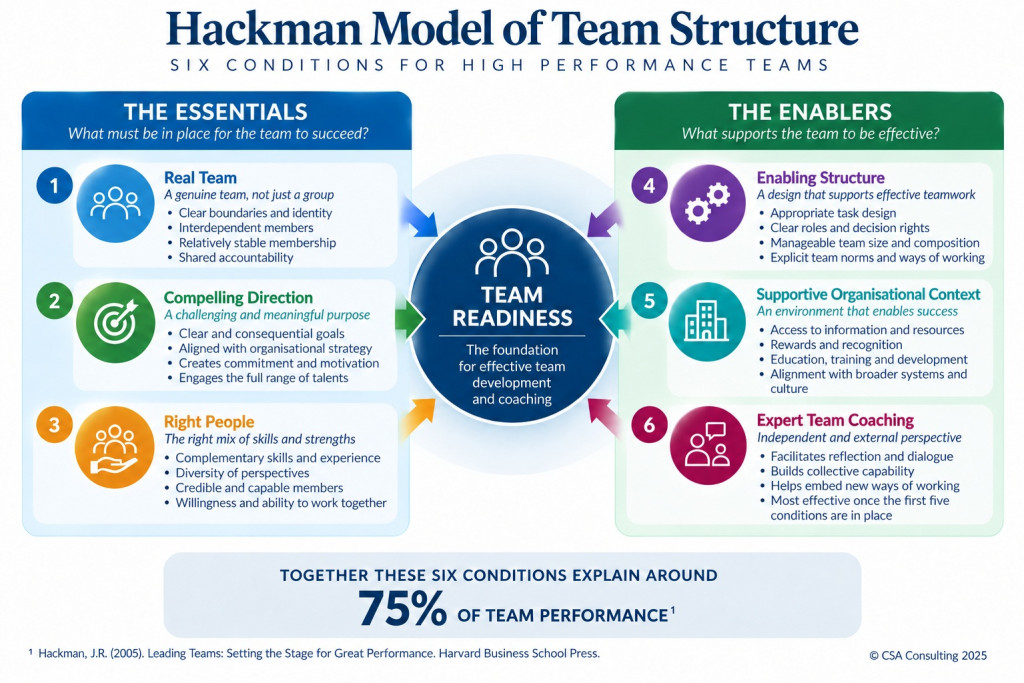
Hackman and Wageman distinguish between three essential conditions that establish whether a real team exists and three enabling conditions that determine whether that team can perform effectively. This distinction is important: the essentials are the foundations. If they are weak, subsequent coaching is likely to have limited impact. The enablers create the environment in which a well-designed team can convert its capability into sustained performance.
The three essentials
Real Team – The team has clear boundaries, meaningful interdependence and sufficient stability of membership. Members know who is in the team, why they need one another and what work genuinely requires collective rather than parallel effort. Without this condition, a nominal executive team can operate as little more than a reporting group.
Compelling Direction – The team has a purpose that is clear, challenging and consequential. It provides focus, stretches the team and gives members a reason to commit their collective capability. In executive teams this also means clarity about the value the team creates for the organisation and its key stakeholders, not simply the aggregation of individual functional objectives.
Right People – The team has the capability, experience and diversity required by its task. This includes technical competence, interpersonal capability and complementary strengths. The question is not whether each member is individually strong, but whether the team as a whole has the right mix of expertise and capacity to deliver its collective purpose.
A strength-based perspective deepens this criterion. The issue is not simply whether talented people are present, but whether the team understands the strengths available to it, regards those strengths as credible and can coordinate them against the work. MacKie’s strength-based team coaching model therefore treats strengths awareness, alignment and coordination as part of team readiness, while also recognising that critical weaknesses or structural flaws need to be addressed before strengths can be fully leveraged.
The three enablers
Sound Structure – The work is designed so that the team can exercise judgement and coordinate meaningfully. Team size and composition are appropriate, roles and decision rights are sufficiently clear, and core norms guide how members participate, challenge, decide and hold one another accountable. Hackman highlighted commitment, transparency, participation and integrity as particularly important norms.
Supportive Organisational Context – The wider organisation helps rather than hinders the team. Reward and recognition systems reinforce collective performance, information is available when needed, and members have access to the resources, education and support required to do the work. For executive teams this also includes governance, Board relationships, organisational culture and whether the surrounding system rewards collaboration or reinforces functional silos.
Available Expert Coaching – Once the first five conditions are sufficiently strong, coaching can help the team make better use of its collective resources. Coaching is therefore an enabler, not a substitute for poor design. It can strengthen effort, task strategy, learning, reflexivity and the team’s ability to translate its structure into more effective collective performance.
For CSA, this model is a readiness test rather than simply another team diagnostic. It helps determine whether the priority is to redesign the team, strengthen the organisational conditions around it, or proceed into deeper work on team process, leadership and coaching.
Is Your Team Ready for Coaching?
Diagnosing readiness before team development
CSA uses the Team Diagnostic Survey alongside structured interviews, stakeholder feedback and complementary team and leadership assessment to establish the team’s current state. Our 2025 Executive Leadership Team Assessment framework broadens this diagnosis across structure, process, leadership, developmental stage, outcomes, challenges, context, drivers, barriers, competence and culture. This avoids treating a team issue as purely interpersonal when the real constraint may lie in team design, governance, strategic context, overload, resources or organisational culture.
- the team has a clear and consequential purpose that requires genuine collective work
- membership and team boundaries are sufficiently clear
- the team contains the right mix of capability, experience and complementary strengths
- roles, accountabilities and decision rights support rather than impede performance
- the organisational context provides the information, resources, recognition and support the team requires
- the team leader and members are genuinely ready to invest in collective development.
From diagnosis to action
Team Readiness is not simply an assessment exercise. The purpose is to determine what conditions need to change before expecting the team to perform differently. The resulting analysis gives the team leader and members a clear picture of existing strengths, structural barriers and development priorities.
It can then inform changes to team membership, roles, governance and ways of working, and establish whether subsequent work should focus primarily on Team Process, Team Leadership or a broader Team Coaching intervention.
Evidence is deliberately triangulated rather than relying on team self-report alone. Depending on the question, CSA can combine team-member perspectives with Board, direct-report and customer feedback, structured interviews, organisational outcome data and validated instruments such as the TDS, MLQ Team and Shared Leadership Survey.
The central question: Does this team have the conditions it needs to succeed?
When to use our Team Readiness services
- New teams, where there is a strong focus on getting to know one another and understanding common values within the team
- Existing teams where the team members are looking to improve their (already sound) performance and become a high-performing team
- Existing teams where there is considerable dysfunction and team members are looking to repair relationships and improve functioning
- Mergers and integrations where previously distinct teams are being combined
- Teams where a significant number of team members have undergone individual leadership coaching and you are looking to leverage these insights at a team level