

Executive Assessment
Executive assessment at CSA Consulting provides a rigorous, evidence-based understanding of an executive’s current capability, distinctive strengths, development needs and future potential. Rather than relying on a single psychometric score or competency framework, we integrate multiple sources of evidence to develop a rounded view of the individual and the context in which they are most likely to perform and flourish.
Our approach builds on Individualised Psychological Assessment (IPA), combining an extensive career and leadership interview, validated psychometric assessment, relevant performance and biographical data, and structured feedback. The objective is not simply to describe the executive, but to understand how their psychological characteristics, strengths, experience and leadership behaviour are likely to influence effectiveness in a particular role and organisational context.
When Executive Assessment adds Value
- CEO and senior executive selection
- Chair and NED roles
- internal appointment and promotion decisions
- succession planning and high potential identification
- career transition and role readiness
- executive coaching and leadership development
- benchmarking leadership capability against current and future role requirements.
The CSA approach to Executive Assessment
Depending on the purpose of the assessment, measures may include personality, potential derailers, motives and values, cognitive and reasoning capability, leadership behaviour, developmental readiness and multi-rater feedback. Frequently used tools include the Hogan Leadership Suite and the Multifactor Leadership Questionnaire (MLQ-360), supplemented by other validated measures where they add value.
What We Assess
- intellectual capability, reasoning style, judgement and strategic thinking
- emotional and motivational characteristics
- interpersonal style, influence and stakeholder impact
- self-awareness, psychological insight and developmental readiness
- leadership and management style
- values, motives and alignment with organisational purpose
- demonstrated performance, experience and role-relevant capability
- potential for larger, more complex and more demanding future roles.
A Strength's Based Approach to Executive Assessment
We therefore identify strengths through a combination of psychometric assessment, structured interview and, where appropriate, multi-rater feedback. Peak-experience and feed-forward interviewing can reveal the conditions in which an executive is energised and effective, while stakeholder feedback shows whether those strengths are visible and valuable to others.
Importantly, a strength is not automatically beneficial in every situation. We consider whether strengths are underused, effectively deployed, overused or poorly aligned with the demands of the role. This provides a more useful basis for selection and development than a simple list of ‘top strengths’.
Assessing Future Potential
Potential is not simply a fixed characteristic residing within the individual. The same executive may flourish in one environment and struggle in another. We therefore consider the context in which strengths are likely to be expressed effectively, including strategic demands, organisational culture, role scope, executive team dynamics, governance expectations and the degree of complexity the individual will be required to navigate.
This contextual perspective helps organisations move beyond the question ‘Is this person high potential?’ towards the more useful questions: ‘Potential for what?’, ‘In which context?’ and ‘What conditions will enable this person to perform at their best?’
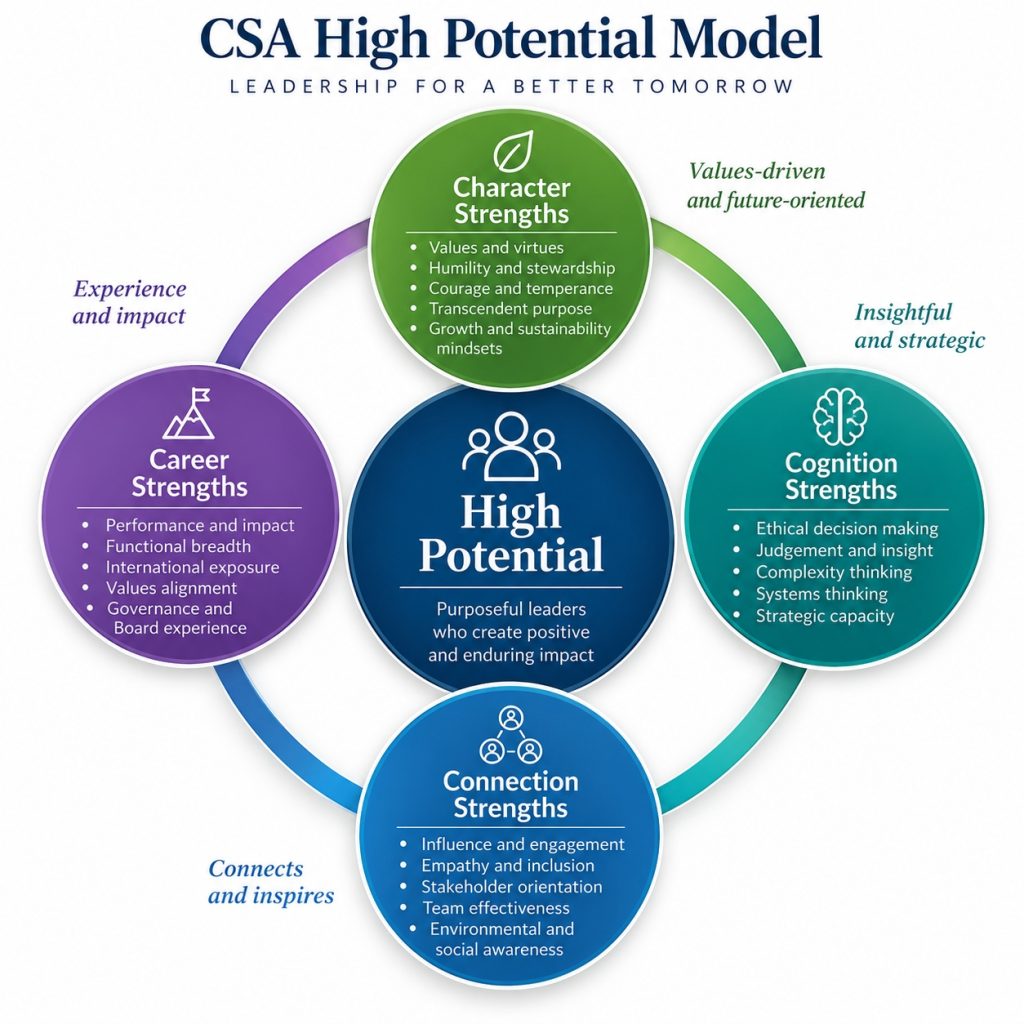
The CSA High Potential Model brings this future-oriented perspective into the assessment process. It considers four interconnected domains of potential: Character, Cognition, Connection and Career strengths.
| Character Strengths
Values, virtues, humility, courage, stewardship, purpose and responsible leadership. |
Cognition Strengths
Ethical decision-making, judgement, reasoning, complexity, systems thinking and strategic capacity. |
| Connection Strengths
Self-awareness, influence, empathy, stakeholder inclusion, engagement and team effectiveness. |
Career Strengths
Performance, experience, functional breadth, values alignment, purpose and governance exposure. |
Connecting Assessment and Development
Where appropriate, findings can be benchmarked against organisational leadership capabilities and the requirements of the target role. For development and coaching assignments, the assessment becomes the foundation for focused development goals that build on existing strengths while addressing the capabilities most important for future effectiveness.
The Questions We Seek to Answer
- Can this executive perform the role effectively now?
- What distinctive strengths do they bring?
- What could constrain or derail their effectiveness?
- How ready and able are they to develop?
- What is their potential for greater complexity and responsibility?
- In what organisational context are they most likely to flourish?