

Nature Positive
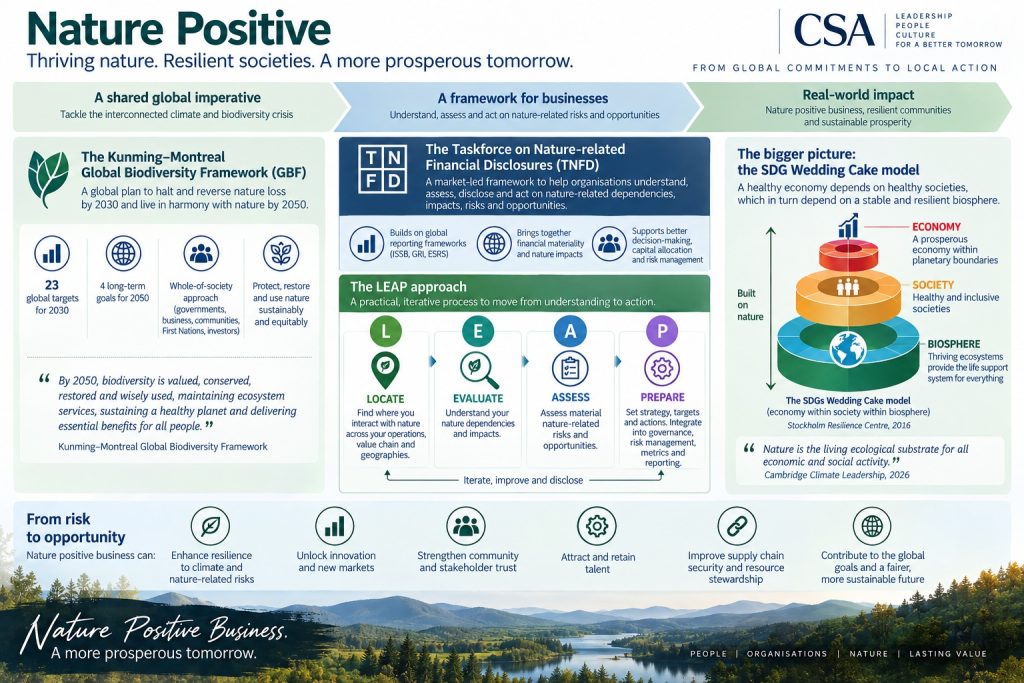
Nature Positive therefore needs to be understood as more than a new environmental agenda. It represents a fundamental shift in how organisations understand their relationship with the biosphere: from treating nature as an external resource or impact category to recognising ecological integrity as a foundational condition for human, organisational and economic activity.
The Ecological Substrate
A central premise of CSA’s Climate Change Leadership research is that biodiversity and ecological integrity form the living substrate on which all human and organisational activity depends. Organisations are not separate from nature. They are embedded within ecological systems and depend upon them for water, energy, materials, food, climate regulation, healthy communities and resilient supply chains.
This challenges the conventional assumption that economic and social systems can be considered independently of the natural world. Human progress is not independent of ecological constraints. It is contingent upon the resilience and flourishing of the living systems within which society and the economy remain embedded. The implication for leadership is significant. Biodiversity is not one sustainability issue among many. It is part of the ecological foundation that makes economic and social prosperity possible.
The Dependency of Organisations on Nature
This reverses the logic of conventional ‘three pillar’ or triple-bottom-line models in which environmental, social and economic considerations can appear interchangeable or capable of being traded against one another. The wedding cake model instead makes the dependency explicit: there can be no enduring economy without a functioning society, and no functioning society without a resilient biosphere.
For organisations, this is the foundation of stronger sustainability. Economic prosperity remains essential, but it must be generated within ecological limits rather than through the continuing depletion of the systems upon which prosperity depends.
From the Climate Crisis to the Climate and Biodiversity Crisis
Corporate sustainability has often begun with carbon. Carbon remains critical, but a carbon-centric approach is insufficient. The wider ecological crisis includes biodiversity loss, ecosystem degradation, land-use change, water stress and disruption of the ecological processes that support life.
Climate and biodiversity are deeply interconnected. Organisational responses that focus narrowly on emissions can miss important dependencies, impacts and trade-offs. Effective leadership therefore requires climate literacy and ecological literacy, together with an understanding of how organisational activity interacts with planetary boundaries.
Weak sustainability assumes that losses in natural capital can often be compensated for by financial, technological or human capital. Strong sustainability recognises that some ecological assets, functions and thresholds are critical, non-substitutable and potentially irreversible.
This changes the organisational question. The issue is no longer simply how environmental harm can be offset or compensated for, but how organisations can operate within ecological limits while protecting and restoring the systems on which they depend.
CSA’s approach therefore distinguishes between reducing harm, compensation, conservation, restoration and regeneration. These are not equivalent outcomes, and the integrity of Nature Positive claims depends upon recognising the difference.
Nature Positive: From Harm Reduction to Recovery
The Nature Positive agenda extends organisational attention beyond reducing harm towards halting and reversing nature loss. The Australian Government describes Nature Positive as circumstances in which species and ecosystems are being repaired and regenerating rather than continuing to decline.
The Kunming-Montreal Global Biodiversity Framework provides the international context for this transition, including the global ambition to protect and conserve at least 30% of land and sea and to restore at least 30% of degraded ecosystems by 2030. It also places increasing expectations on organisations to understand and disclose their dependencies and impacts on biodiversity.
For organisations, the practical progression is from understanding dependencies and impacts, to avoiding and reducing harm, and then towards restoration, regeneration and measurable Nature Positive outcomes.
The CSA approach to Nature Positive
What are the benefits of Nature-Based Solutions?
Nature-based solutions (NbS) can deliver substantially broader benefits than carbon offsetting alone. Well-designed NbS can simultaneously remove and store carbon, restore biodiversity and ecosystem function, improve water and soil health, strengthen climate resilience and create benefits for communities. Importantly, the type of intervention matters. Seddon et al. (2020), drawing on Lewis et al. (2019), highlight that natural forest regeneration could store around 40 times more carbon than commercial plantations under the restoration scenarios examined, while also providing substantially greater biodiversity benefits. NbS should therefore not be treated simply as another source of carbon credits, nor as a substitute for direct emissions reduction. A strong sustainability approach prioritises avoiding and reducing emissions and ecological damage first, while using credible, additional and permanent nature-based interventions to restore and regenerate the ecological systems that underpin sustainable prosperity.
CSA therefore connects Nature Positive with sustainable prosperity: organisations creating enduring economic and social value while protecting and contributing to the recovery of the ecological systems on which that value depends. This moves sustainability beyond balancing competing economic, social and environmental interests towards a model in which prosperity is understood as embedded within, and ultimately dependent upon, planetary health.
The destination is not simply lower impact. It is organisational activity capable of contributing to ecosystem-wide flourishing within planetary boundaries.
Our Approach
- Develop climate and ecological literacy at Board and executive levels.
- Identify organisational dependencies and impacts on biodiversity and ecosystems.
- Integrate climate and nature into purpose, strategy, investment and governance.
- Use TNFD and related frameworks to connect ecological evidence with organisational decision-making.
- Assess sustainability maturity from weak towards stronger, regenerative forms.
- Distinguish avoidance and harm reduction from offsets, restoration and regeneration.
- Build ecological reflexivity, systems thinking and long-term judgement.
- Connect Nature Positive ambitions with leadership capability and organisational transformation.
- Frame sustainable prosperity within ecological limits and planetary boundaries.
CSA does not replace ecologists, biodiversity specialists or environmental consultants. Our contribution lies in connecting their technical expertise with leadership, psychology, governance, organisational systems and transformation.