

CEO Effectiveness
At CSA Consulting we take a systemic, evidence-based approach to CEO effectiveness. Drawing on organisational psychology, leadership research and extensive experience working with CEOs, Boards and executive teams, we examine both the capabilities of the CEO and the organisational context in which leadership occurs.
Our approach recognises that what makes an effective CEO varies according to the organisation, its strategy and its stage of development. The leadership required during rapid growth, organisational transformation, acquisition, succession or significant external disruption may be very different from that required in a mature and stable organisation.
A Three-Domain Model of CEO Effectiveness
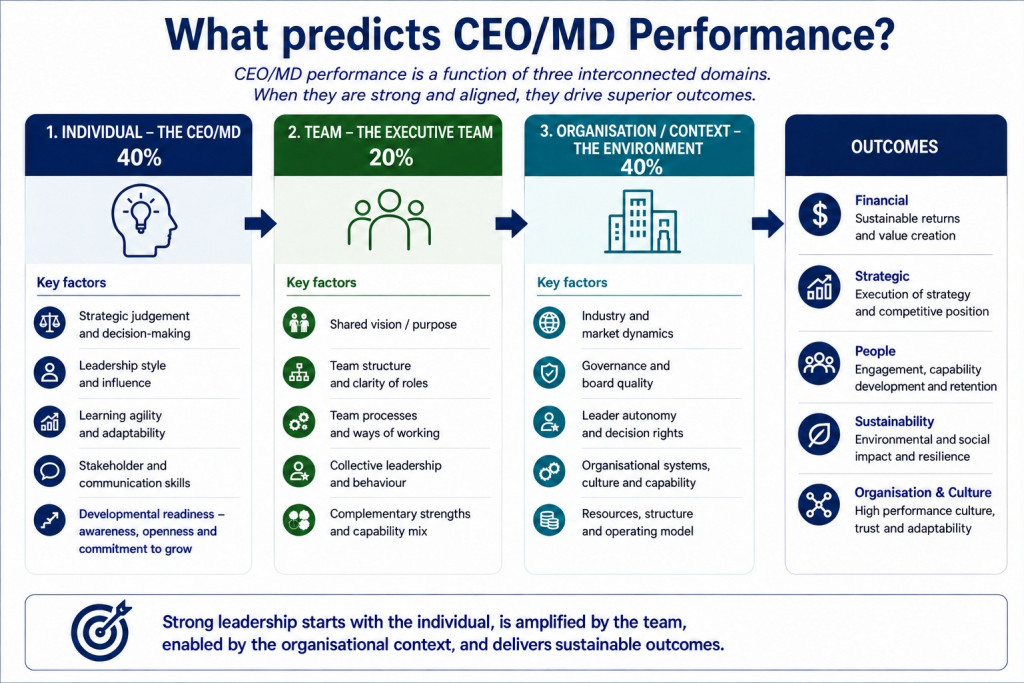
Most executive coaching operates primarily at the level of individual CEO capability. While important, individual factors alone explain only a proportion of overall CEO effectiveness. Our research suggests that individual capability may account for around 25% of performance, although effective strength-based leadership coaching can significantly enhance the contribution made by the individual leader to around 40%.
Maximising CEO performance therefore requires a broader perspective. It is essential to consider the capability and alignment of the ELT, together with the contextual factors that can either enable or inhibit the CEO’s effectiveness. Consequently, an initial CEO coaching engagement will often extend to the executive team, examining team structure, team processes and team leadership, as well as the wider organisational environment in which the CEO and team are operating.
This three-domain model shifts the discussion from an exclusively individual view of leadership to a more systemic understanding of CEO effectiveness. It provides a richer appreciation of the complexity of the CEO role and helps identify the factors that may be facilitating or constraining organisational performance.
The model also helps explain why highly successful executives can struggle when they move into a new organisation. The capabilities that contributed to success in one environment may remain, but the team, governance arrangements, culture, resources, stakeholder expectations and strategic context may be very different.
Importantly, this perspective also broadens the role of the Chair and Board. Rather than viewing CEO performance solely as the responsibility of the individual CEO, it encourages consideration of the conditions, support, governance and organisational resources that the Board can provide to enable the CEO and executive team to perform at their best.
CEO Effectiveness as a System
Our central proposition is that CEO effectiveness is systemic. The CEO influences strategy, the executive team, culture and the wider organisation. At the same time, the Board, organisational resources, stakeholder expectations, market conditions and the external environment can amplify or constrain the CEO’s capacity to perform.
The same CEO can therefore perform very differently in different contexts. Effective CEO selection, development and support require attention not only to who the CEO is, but also to what the role demands, the team they lead and the system in which they operate.
How Context Shapes CEO Effectiveness
CSA considers contextual factors as potential enablers or inhibitors of CEO performance. These include strategic and market conditions, governance and Board dynamics, organisational culture and systems, resources and capabilities, stakeholder expectations, role clarity, organisational lifecycle and external uncertainty. These factors interact with the CEO’s capabilities, personality, motives and experience to shape leadership effectiveness and organisational outcomes.
The CSA Approach to Assessing CEO Effectiveness
What We Examine
Individual capability and leadership strengths. The CEO’s cognitive, interpersonal and leadership capabilities, experience, motivations, values and distinctive strengths.
Role and strategic context. The extent to which the CEO’s capabilities and leadership approach match the current and emerging strategic requirements of the organisation.
CEO and Board relationship. The quality of the relationship between CEO, Chair and Board, including role clarity, trust, challenge, accountability, information flow and governance of organisational performance.
Executive team effectiveness. The CEO’s ability to build and lead an effective executive team with clarity of purpose, appropriate capability, constructive team processes and collective accountability.
Culture and organisational impact. The impact of CEO behaviour on organisational culture, leadership capability, decision-making and the wider organisational system.
Sustainability and future readiness. The capacity to lead beyond immediate performance requirements and respond effectively to longer-term strategic, societal and environmental challenges.
Our Approach
CSA’s approach to CEO effectiveness integrates assessment, feedback, coaching and advisory support.
Where appropriate, the process begins with a rigorous assessment of the CEO’s strengths, capabilities, developmental areas and leadership context. This may draw on structured career interviews, psychometric assessment, multi-rater feedback, organisational data and discussions with the Chair or other key stakeholders.
We do not rely on psychometric scores in isolation. Assessment data are interpreted alongside biographical, behavioural, organisational and performance information to develop a more complete understanding of the individual and their context.
The resulting analysis can provide the foundation for CEO coaching, Board and Chair discussions, executive team development or a broader CEO effectiveness programme.