

Team Leadership
Leadership, not leaders
Shared leadership is an emergent property of the team in which leadership influence is distributed across multiple members. It reduces the traditional distinction between leader and follower and allows different members to exercise leadership when their capability and the context make that appropriate.
This does not make the formal leader redundant. Effective shared leadership requires a different and often more sophisticated contribution from the CEO or team leader: creating clarity, empowering others, maintaining accountability and deliberately developing the collective leadership capacity of the team.
Developing Collective Leadership in a High-Performing Team
This is where the strength-based and shared-leadership approaches become mutually reinforcing. Shared leadership works best when capable team members can differentiate their contribution according to strengths and expertise. Rather than asking every executive to demonstrate the same leadership behaviours, CSA helps the team identify where particular strengths can best be deployed, paired with complementary strengths and translated into informal leadership roles. This increases the team’s collective leadership capacity while preserving clear accountability.
This becomes particularly important as executive teams confront complex and wicked problems. MacKie’s recent work argues that team leadership increasingly needs responsible, ethical, systemic, sustainable and adaptive capabilities, with leadership distributed according to expertise, strengths and the demands of the situation.
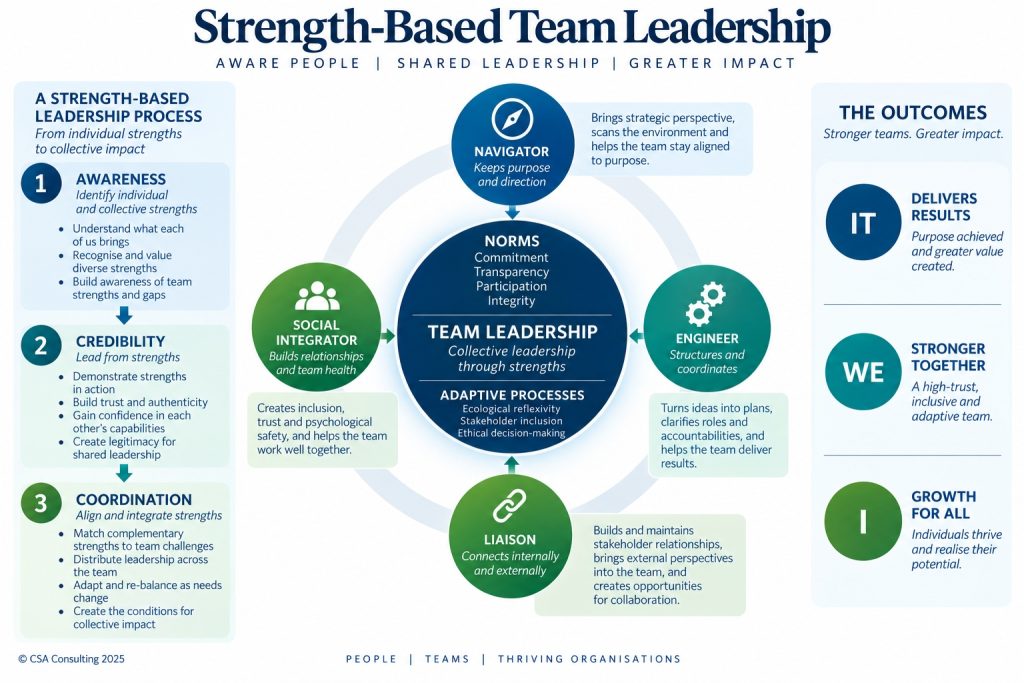
Four collective leadership functions are particularly useful:
- Navigator – maintains purpose and strategic direction.
- Engineer – structures and coordinates work to achieve collective goals.
- Social Integrator – maintains relationships, cohesion and the health of the team.
- Liaison – develops and maintains relationships with critical stakeholders beyond the team.
Different team members can contribute leadership at different times according to their strengths, expertise and context. The objective is not leadership without hierarchy, but a more intelligent use of the leadership capacity already present within the team.
The central question: How effectively does this team exercise leadership collectively?
A Strength-Based approach to Team Leadership
The Benefits of Team Leadership
Effective team leadership extends leadership capacity beyond the formal leader by enabling influence, expertise and responsibility to be shared across the team. Research consistently associates shared leadership with greater team effectiveness. Wang, Waldman and Zhang’s (2014) meta-analysis of 42 studies found positive relationships across attitudinal, behavioural and performance outcomes, while Nicolaides et al. (2014), reviewing 54 studies involving 3,882 teams, found that shared leadership explained an additional 5.7% of variance in team performance beyond vertical leadership alone. D’Innocenzo et al. (2014) similarly support the positive relationship between shared leadership and team performance, while Barnett and Weidenfeller (2016) conclude that the overall relationship with team effectiveness is positive, albeit with some limitations in the research base. Importantly, this does not mean eliminating hierarchy. Hierarchy can provide direction, decision-making efficiency, role clarity and coordination, but excessive hierarchy can suppress diverse expertise, creativity, voice and adaptability. The opportunity for executive teams is therefore to combine the benefits of vertical leadership with the additional capacity of shared leadership, creating a more flexible leadership system in which team members contribute their distinctive strengths and expertise, particularly when addressing complex, interdependent challenges.
References:
Burke, C. S., Stagl, K. C., Klein, C., Goodwin, G. F., Salas, E., & Halpin, S. M. (2006). What type of leadership behaviors are functional in teams? A meta-analysis. The Leadership Quarterly, 17(3), 288-307.
D’Innocenzo, L., Mathieu, J. E., & Kukenberger, M. R. (2016). A meta-analysis of different forms of shared leadership-team performance relations. Journal of Management, 42(7), 1964-1991.
MacKie, D. (2019). Models of shared leadership and team coaching. In D. Clutterbuck, J. Gannon, S. Hayes, I. Iordanou, K. Lowe, & D. MacKie (Eds.), The Practitioner’s Handbook of Team Coaching. Routledge.
Nicolaides, V. C., LaPort, K. A., Chen, T. R., Tomassetti, A. J., Weis, E. J., Zaccaro, S. J., & Cortina, J. M. (2014). The shared leadership of teams: A meta-analysis of proximal, distal, and moderating relationships. The Leadership Quarterly, 25(5), 923-942.
Wang, D., Waldman, D. A., & Zhang, Z. (2014). A meta-analysis of shared leadership and team effectiveness. Journal of Applied Psychology, 99(2), 181-198.