

Executive Coaching
Executive coaching at CSA is an evidence-based leadership development process designed to enhance the effectiveness of CEOs, executives and senior leaders. Our approach is grounded in organisational psychology, rigorous assessment and strength-based development, with a clear focus on translating insight into observable leadership behaviour and organisational impact.
Leadership does not occur in isolation. Effective coaching considers the individual leader, the executive team and the wider organisational context in which leadership is exercised. The objective is not simply to help executives feel more confident or self-aware, but to develop leadership capability that is relevant to the challenges they actually face.
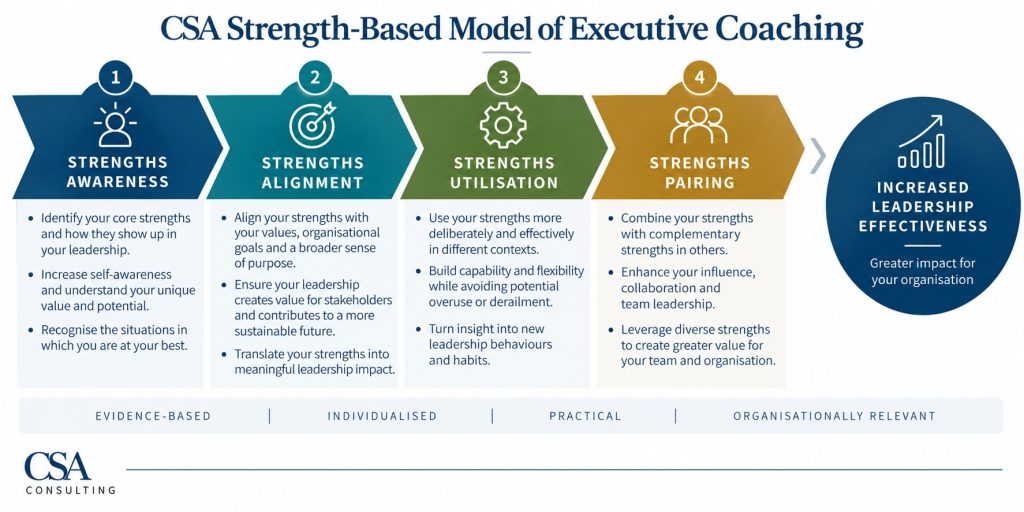
Strength-Based Executive Coaching
The approach recognises that strengths are not automatically beneficial simply because they are used more often. They can be underused, overused or poorly matched to the situation. Effective strengths development therefore requires careful attention to context, organisational purpose and the capabilities of others.
Readiness for Executive Coaching
What is Developmental Readiness?
1. Motivation to Develop
- Motivation to lead – does the leader actually want to be a leader? Is this their professional identity?
- Leader self-confidence – how confident are they in their own ability to lead? Do they have the right resources and support?
- Motivation to learn – are they motivated to learn new skills? Is the drive intrinsic or extrinsic? Do they believe it’s possible to develop as a leader?
- Goal orientation – do they have the focus to set and meet developmental goals? Are their goals concordant with their values? Are they mastery orientated?
2. Ability to Develop
- Awareness of strengths & weaknesses – is the leader aware of their abilities, as perceived by others? Are they leveraging their strengths and managing their weaknesses?
- Awareness of thinking – does the leader listen to their ‘self-talk’ and understand the impact that this can have on their development?
- Emotional regulation – does the leader have the ability to understand the impact of their emotions on themselves and others and regulate this?
- Perspective taking – can the leader take a variety of perspectives on a position and show psychological flexibility in doing so?
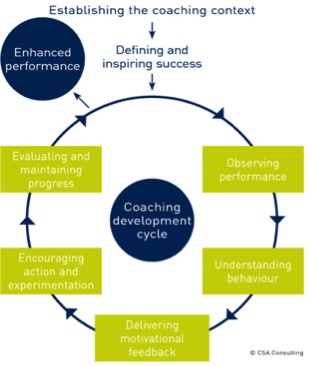
What do we assess in Executive Coaching?
- Executive interview and contextual analysis
- Validated psychometric and strengths assessment
- Leadership assessment and 360-degree feedback
- Stakeholder perspectives and organisational data
- Identification of strengths, potential derailers and development priorities
When to use our Executive Coaching services
- Leadership effectiveness and transition into CEO or executive roles
- Strategic leadership, judgement and decision-making
- Strengths development, self-awareness and behavioural flexibility
- Stakeholder influence and executive team leadership
- Leading organisational change, complexity and uncertainty
- Purpose, values and sustainability leadership