

Boards & Governance
CSA brings an organisational psychology perspective to governance. Our work with Boards, Chairs, CEOs and executive teams spans CEO and executive assessment, succession, leadership transitions, Board and executive dynamics, organisational culture and senior leadership development. This provides a distinctive perspective on the less visible factors that influence governance effectiveness, including the Chair-CEO relationship, constructive challenge, strategic clarity, information flows, decision-making, culture and leadership capability.
Governance & Leadership
One of the Board’s most consequential responsibilities is ensuring that the organisation has the leadership required to deliver its strategy. This extends beyond CEO appointment to understanding executive capability, succession, executive team effectiveness and the organisational conditions that enable leadership performance.
CSA approaches leadership effectiveness as a system. CEO capability matters, but so do the capability and alignment of the executive team and the broader organisational and governance context in which leadership occurs. This enables Boards to consider not only who is leading the organisation, but whether governance, culture, strategy and organisational systems enable those leaders to perform effectively.
Governance for a Complex World
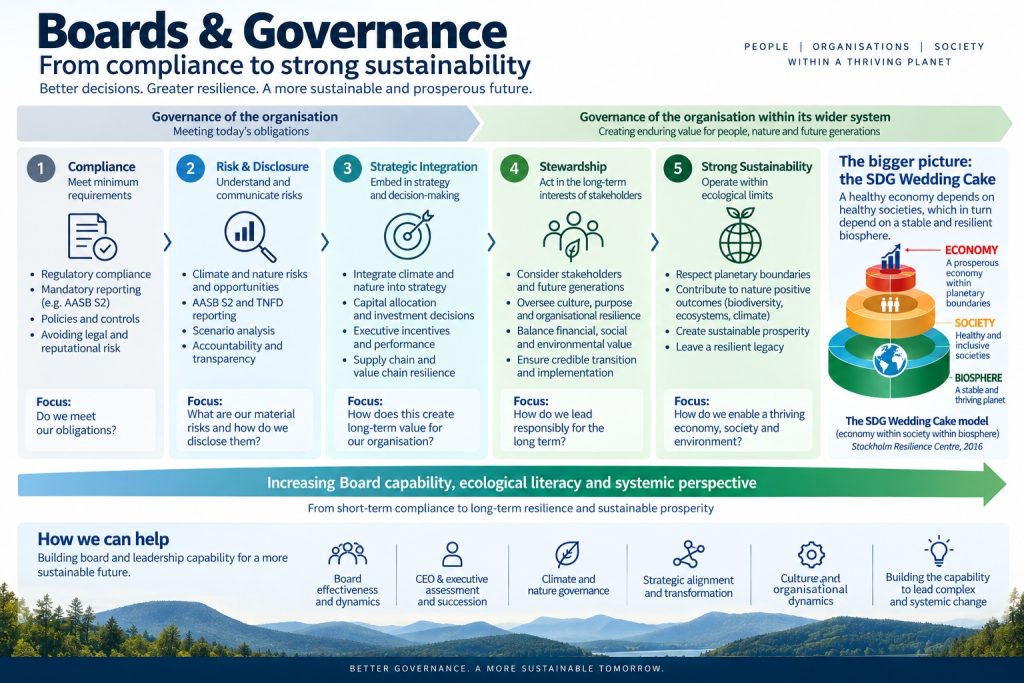
Climate reporting illustrates this shift. Australia’s AASB S2 requirements represent a substantial uplift from the former TCFD framework, requiring greater specificity around Board oversight, strategic time horizons, transition planning, financial effects and the integration of climate considerations into organisational decision-making.
Nature is following a similar trajectory. Recent Australian director research shows that nature-related risks are increasingly recognised as governance concerns, but formal oversight, capability and disclosure remain uneven. More advanced Boards are more likely to request nature strategies, recruit expertise, establish metrics and targets and integrate climate and nature considerations.
From Compliance to Stewardship
This is particularly evident with nature. Around half of Australia’s GDP is estimated to depend directly or indirectly on nature and its ecosystem services. Nature is therefore not simply an environmental issue. It is increasingly a matter of governance, resilience, strategic risk, opportunity and value creation.
This broader conception of stewardship aligns with CSA’s approach to governance. It requires Boards to consider financial outcomes alongside stakeholder impacts, longer-term consequences, organisational purpose and the ecological systems that underpin economic activity.
Climate & Nature Governance?
The Taskforce on Nature-related Financial Disclosures (TNFD) provides Boards with a practical means of beginning this process. Its LEAP approach asks organisations to Locate their interfaces with nature, Evaluate dependencies and impacts, Assess material risks and opportunities, and Prepare their governance, strategy, risk management, metrics and targets in response.
CSA’s role is not to replace specialist climate, legal, accounting or ecological expertise. It is to help Boards and executive teams integrate these emerging issues into leadership, governance, organisational decision-making and strategy.
When to use our Boards & Governance services
- CEO and executive assessment, succession and transition.
- Board, Chair, CEO and executive team effectiveness.
- Leadership capability and organisational culture.
- Role clarity, strategic alignment and decision effectiveness.
- Climate and nature governance and Board capability.
- Integration of sustainability considerations into strategy, risk, capital allocation and executive accountability.
- Facilitated strategic and governance discussions on complex and systemic challenges.
The objective is stronger governance through better leadership, better judgement and a more systemic understanding of the organisation and the environment in which it operates.