

Team Coaching
What is Team Coaching?
‘direct interaction with a team intended to help members in the co‐ordinated and task‐appropriate use of their collective resources in accomplishing the team’s work.’
A number of practitioners have also attempted to define team coaching in a way that is easily comprehensible for organisations. For instance, David Clutterbuck (2009) defines team coaching as:
‘Helping the team improve performance and the processes by which performance is achieved, through reflection and dialogue.’
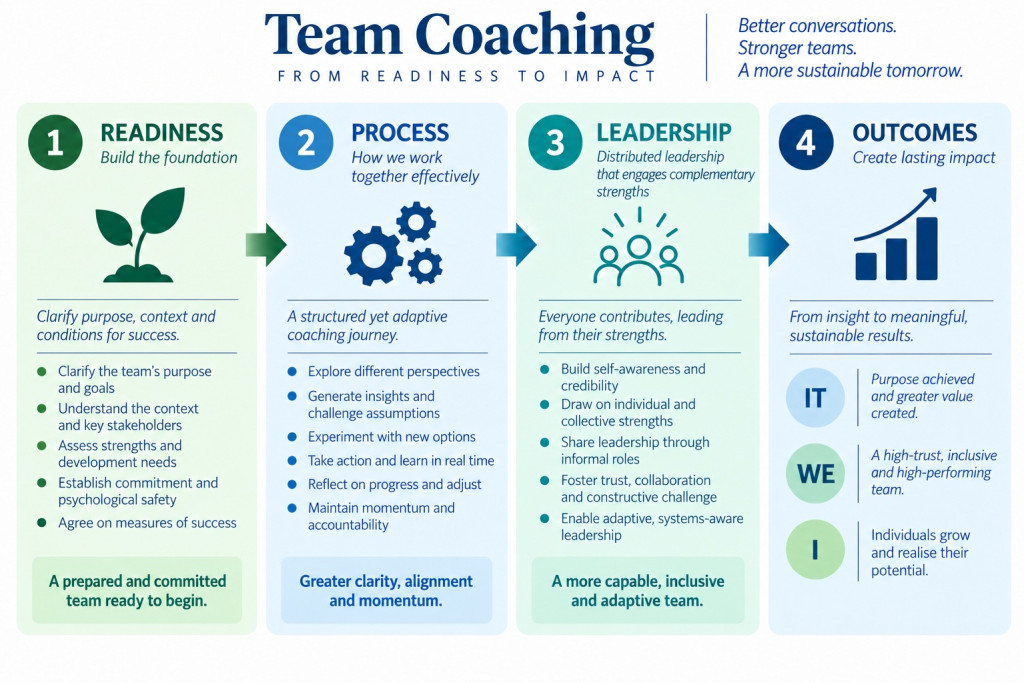
It’s too early to be definitive about best practice methodology in team coaching but there are some emerging models that have an empirical basis behind them including Hawkins 5C model (Hawkins, 2016) and strength-based approaches, (MacKie, 2018). However there is clear convergence on what good outcomes look like in terms of enhanced performance, improved social process and team member development.
The Foundations of Team Coaching
Like individual coaching, team coaching draws on a variety of individual and systemic behavioural change techniques. You will typically experience a feedback process designed to raise individual awareness regarding leadership strengths and development areas. A reliable and well-validated 360 assessment tool like the MLQ360 is ideal for this. In addition, you can expect a team diagnostic to be applied prior to the commencement of your team coaching as this allows team members and other key stakeholders to provide feedback on how the team is performing. The Team MLQ is a highly reliable and valid diagnostic that can provide this data. Depending on what the diagnostic shows you can expect your team coach to focus you on a number of areas including your team process – how you work together, your team norms – what are the rules around participation and integrity, and your individual development – what have you learned about your own leadership style that other team members would benefit from knowing? Team coaching usually culminates in the production of a team development plan and a team charter that outlines purpose, vision, mission and values. Awareness of team process (team reflexivity) is a critical component of high-performing teams and is enhanced through the use of after action reviews (AARs), (Kondrat et al, 2016). Tannenbaum & Cerasoli (2012) examined the impact of AARs and found they increase team effectiveness by 25% in 46 studies.
The CSA approach to Team Coaching
- Collective awareness of the variety of strengths in the team
- Reliance and trust in those strengths in the execution of team tasks
- Co-ordination of tasks and allocation of team roles based on strengths
Collective strength use requires awareness, credibility and co-ordination. Moderators of this approach include Strength diversity, strength-based climate & task complexity. Research suggests that strength credibility is the most important factor in enhancing team performance, (Meyers et al, 2023). The more complex the decision the more critical it is to utilise the collective strengths of the team in its resolution. Having a diversity of strengths and a positive team climate also augments the impact. This approach however can create a tension between personal and collective excellence and the resolution of this is a key task for the team.
Critical Questions in Team Coaching?
- Does the team have a compelling purpose?
- How does the team hold itself accountable?
- Does the team have a shared vision and purpose?
- How do team members give each other feedback?
- How does the team align strengths and roles?
- How effective is the communication – internally & externally?
- How effectively does the team manage conflict?
- How effectively does the team make decisions?
- What kind of leadership style does the team endorse?
- How distributed or shared is leadership within the team?
- What is the team’s relationship with its leader?
- How well does the team balance its focus on task, behaviour and learning?
- What is the culture in which the team operates?
- How effectively does the team engage with its stakeholders?
How to prepare for Team Coaching?
- What are three of our team behaviours and/or conditions that most effectively move us towards greater success?
- When are we at our best and what are the factors that make this so?
- What three team behaviours and/or conditions interfere most with our effectiveness and/or results?
- What do the team’s stakeholders most require from this team in the future?
- How would you rate the current effectiveness of the team on a scale of 1 to 10, low to high effectiveness?
- What level of effectiveness would be required for the team to meet its goals and expectations in the next 12 months on a scale of 1 to 10, low to high effectiveness?
- What three changes would support the team to achieve even greater effectiveness and results together?
- When do we make our most effective decisions and how do we do this?
- What are my individual strengths that could be more fully utilised within the team?
- What can we do together that we cannot do apart?
- Where are the opportunities to enhance our interconnectedness and reduce silos?