

Sustainability Leadership
CSA focuses on developing the individual leadership capability required to respond effectively to these challenges. The objective is not to turn executives into sustainability specialists. It is to develop leaders who can think more systemically, make more responsible and ethical decisions, engage a wider range of stakeholders, consider the impact they have on distant environments and communities and translate sustainable intent into meaningful action.
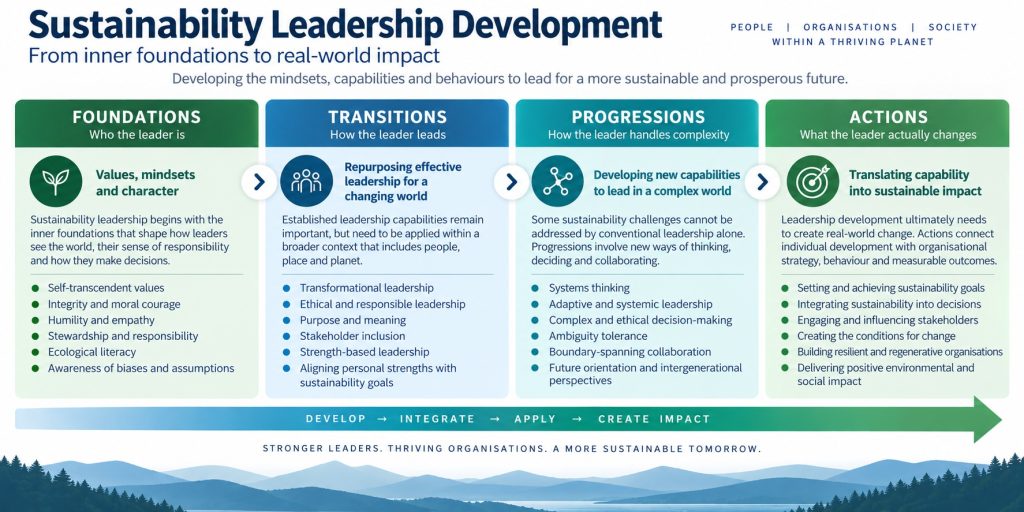
The Foundations, Transitions Progressions & Actions model
1. Foundations – Changing How Leaders See the World
The Foundations stage recognises that sustainability leadership begins before behaviour. It begins with how leaders understand the purpose of business, their relationship with the natural world and the assumptions through which they interpret risk, responsibility and opportunity.
The Handbook highlights the importance of sustainability mindset, ecological worldview, systems thinking, emotional and spiritual intelligence, cognitive bias and the evolutionary influences that shape leadership responses. It also points towards longer-term perspectives, a widening circle of care and a movement from self-enhancing towards self-transcending values.
- Sustainability mindset and ecological worldview
- Self-transcendent values, purpose and stewardship
- Systems thinking and recognition of interdependence
- Emotional intelligence, empathy and a widening circle of care
- Awareness of cognitive biases that can diminish attention to climate and sustainability
- Longer-term and intergenerational perspectives
For leadership development, the central task is to surface the assumptions, values and biases that shape how the leader sees the organisation and its responsibilities within wider social and ecological systems.
2. Transitions – Repurposing Contemporary Leadership
Transitions recognise that many established leadership models remain useful, but are insufficient if their purpose remains narrowly focused on individual exceptionalism, shareholder value or organisational performance alone. Existing leadership capabilities need to be repurposed for the age of sustainability.
The Handbook illustrates this through environmentally specific transformational leadership, responsible leadership and environmental ethics. Transformational leadership is redirected towards environmental role modelling, inspiration, innovation and the development of pro-environmental behaviour. Responsible leadership broadens the stakeholder field, while environmental ethics explicitly locates leadership within the natural world and includes responsibility to future generations.
- Transformational leadership directed towards environmental and sustainable outcomes
- Ethical and responsible leadership
- Purpose-led and strength-based leadership
- Inclusive stakeholder engagement
- Recognition of the natural world as part of the leadership context
- Responsibility to future generations
CSA’s strength-based coaching approach fits particularly well at this stage. Strengths are not developed simply to increase individual performance. They are aligned with a broader purpose and used to increase the leader’s capacity to influence sustainable outcomes.
3. Progressions – Developing New Capabilities for Complexity
Progressions move beyond adapting existing leadership models. They address capabilities that become necessary because complex and wicked sustainability challenges expose the limitations of conventional, linear approaches to leadership.
The Handbook’s Progressions section moves from weak compliance towards stronger regenerative and coevolutionary forms of sustainability. It draws on complex adaptive socio-technical systems, systems and eco-leadership, polarities, restorative approaches, life-cycle thinking, biomimicry and adaptation leadership. The common thread is a shift from seeing isolated problems to understanding relationships, systems and interdependencies.
- Systems thinking and systemic leadership
- Working with polarities such as short-term and long-term, and independence and interdependence
- Adaptive leadership and acceptance of continuing change
- Complex and ethical decision-making under uncertainty
- Boundary-spanning collaboration
- Future visioning and effective information flows
- Understanding the progression from weak towards strong and regenerative sustainability
These capabilities are transferable well beyond sustainability. They strengthen a leader’s ability to navigate organisational transformation, technological disruption, stakeholder conflict and other complex strategic challenges.
4. Actions – Closing the Gap Between Intent and Impact
The final stage translates leadership capability into tangible and meaningful action. The Handbook describes this as closing the gap between the intent and impact of corporate sustainability. For individual leaders, this means converting values, purpose and systemic understanding into decisions, goals, influence and organisational change.
Actions include setting substantive sustainability goals, considering double materiality, distinguishing genuine environmental ambition from symbolic commitments, engaging stakeholders and ensuring that sustainability is reflected in strategy and decision-making. The Handbook also highlights the changing role of coaching, shared leadership and systemic collaboration in enabling leaders to act effectively.
- Setting meaningful and externally grounded sustainability goals
- Using double materiality to consider both risks to the organisation and impacts created by the organisation
- Distinguishing substantive action from symbolic commitments
- Integrating climate, nature and sustainability into leadership decisions
- Engaging and influencing stakeholders across organisational boundaries
- Mobilising shared and distributed leadership rather than relying on individual exceptionalism
- Using coaching and development to support adaptive behaviour and systemic action
The emphasis is therefore not on sustainability knowledge alone, but on whether the leader can convert that knowledge into credible action and positive impact.
Assessing Sustainability Leadership
- Values and virtues – including self-transcendent values, character strengths, wisdom, humanity and transcendence, using approaches such as the VIA Character Strengths and Schwartz values framework.
- Personality and character – including honesty-humility, emotionality, extraversion, agreeableness, conscientiousness and openness through instruments such as HEXACO.
- Sustainability mindset – examining ecological worldview, systems perspective, emotional intelligence and spiritual intelligence through the Sustainability Mindset Indicator (SMI).
- Responsible leadership – assessing stakeholder relations, ethics and values, self-awareness, systems thinking, and change and innovation through the Competency Assessment for Responsible Leadership (CARL).
- Environmentally specific transformational leadership – examining transformational leadership with an environmental focus using the ETFL 12-item scale.
- Adult development and leadership maturity – exploring the leader’s capacity to move through Kegan’s stages of adult development, including self-authoring and self-transforming ways of understanding complex systems.
What are the benefits of Sustainability Leadership?
- Foundations – values, virtues, mindset, character and self-awareness
- Transitions – responsible, ethical and environmentally focused leadership behaviour
- Progressions – systems thinking, maturity and capacity to manage complexity
- Actions – translating capability into sustainable goals, decisions and impact
This allows the coaching process to be tailored to the individual leader rather than assuming that all executives require the same sustainability competencies. Assessment is therefore used as the starting point for a focused developmental pathway through the Foundations – Transitions – Progressions – Actions model.
Sustainability as a Transferable Leadership Capability
Sustainability provides an unusually demanding context in which to develop leadership. It requires leaders to work across systems, reconcile competing priorities, engage diverse stakeholders, consider long-term consequences and act without certainty. These are also capabilities required for many of the most difficult challenges facing contemporary organisations.
Sustainability Leadership is therefore distinct from CSA’s Climate Advisory work. Sustainability Leadership develops the individual leader. Climate Advisory focuses on the wider organisational system, including governance, strategy, culture, climate and nature transition. Together they connect individual capability with organisational transformation.