

Culture & Purpose
Aligning why the organisation exists with how it behaves
Culture and purpose are closely connected but distinct. Purpose defines why an organisation exists, the contribution it seeks to make and the direction it provides. Culture is the pattern of shared assumptions, values, behaviours and norms through which that purpose is interpreted and enacted. In practical terms, culture is how priorities are understood, how decisions are made under pressure, what people believe really matters and what happens when no one is watching.
CSA takes an organisational psychology, leadership and systems perspective. We are interested not simply in whether an organisation has an attractive purpose statement or a positive culture, but whether purpose, strategy, leadership, values, systems and everyday practices are sufficiently aligned to support sustained performance and positive impact.
Defining Organisational Purpose
Purpose can perform several organisational functions. It can motivate employees and teams around a common focus, attract talent and stakeholders, provide direction, help resolve complex decisions and tensions, and establish the broader purpose that leadership is intended to serve. This makes purpose particularly valuable when organisations face uncertainty, competing stakeholder expectations or strategic transformation.
Connecting Organisational Culture & Purpose
Designing Credible Purpose
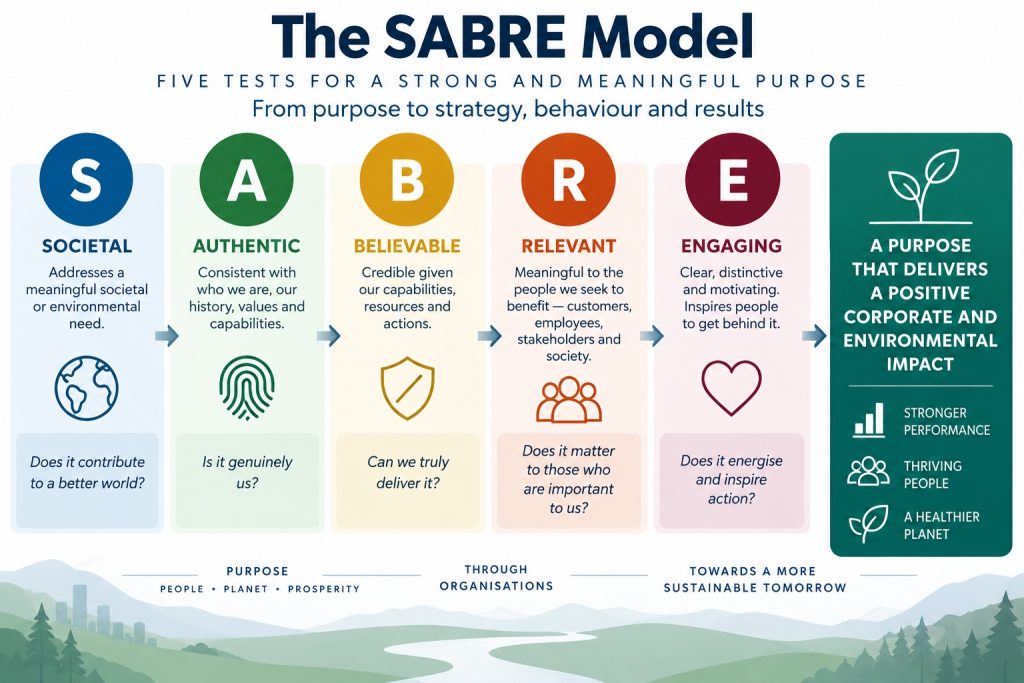
CSA draws on contemporary purpose frameworks rather than treating purpose as a branding exercise. The SABRE model provides a useful test of whether purpose is Societal, Authentic, Believable, Relevant and Engaging. Effective purpose should also be sufficiently precise to guide action without unnecessarily limiting future development, memorable enough to influence behaviour, authentic to the organisation, enduring, and explicit about the wider contribution the organisation seeks to make.
The critical test is credibility. Can the organisation deploy its resources and capabilities towards the purpose, measure progress and demonstrate that the purpose influences consequential decisions? A purpose that is disconnected from strategy, governance, investment, performance measures and culture risks becoming symbolic rather than substantive.
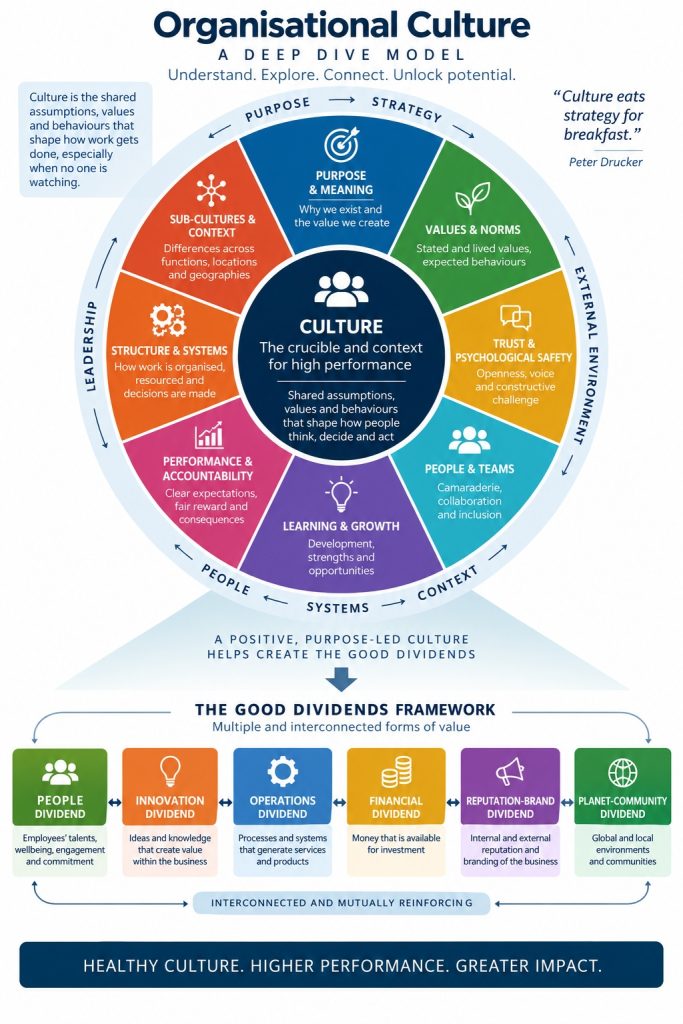
What are the key components of Culture?
- Purpose and meaning – whether people understand why the organisation exists and how it creates value for employees, customers, communities and other stakeholders.
- Values and behavioural norms – the extent to which stated values guide actual behaviour, particularly under pressure.
- Leadership and decision-making – how senior leaders shape culture, distribute authority, manage tensions and involve others in decisions.
- Trust, camaraderie and psychological safety – whether people can speak up, challenge decisions and contribute different perspectives.
- Collaboration and interdependence – how effectively different parts of the organisation work across boundaries and how this affects customers and innovation.
- Learning, growth and strengths – whether people can develop, contribute their strengths and learn from experience.
- Performance and accountability – what is rewarded, how success is defined and how underperformance is addressed.
- Subcultures and organisational context – where different parts of the organisation develop distinctive norms and whether these support or inhibit effectiveness.
From Good Culture to Good Dividends
This shifts the question from ‘Do we have a good culture?’ to ‘How does our culture help the organisation create good outcomes across the systems and stakeholders affected by it?’ It also aligns culture more directly with CSA’s wider focus on leadership effectiveness, sustainable prosperity and positive organisational impact.
The CSA Approach to Culture and Purpose
CSA works with Boards, CEOs and executive teams to understand the relationship between purpose, culture and organisational effectiveness. Our approach is tailored to context and can combine purpose review and development, culture diagnostics, confidential interviews, employee survey evidence, leadership and team assessment, stakeholder perspectives and facilitated executive workshops.
Rather than applying a single generic culture model, we select methods according to the organisational question. Established approaches such as the Competing Values Framework, Denison model, Organisational Culture Inventory and leadership-culture diagnostics can provide useful structure. Qualitative cultural deep dives complement survey data by examining the behaviours, assumptions and tensions that standard measures can miss.
The result is an evidence-based view of cultural strengths, development priorities and the degree of alignment between purpose, strategy, leadership and everyday organisational behaviour. The emphasis is on identifying what should be preserved, what needs to change and which leadership or system conditions will make change sustainable.
Selected references
Assoratgoon, W., & Kantabutra, S. (2023). Toward a sustainability organizational culture model. Journal of Cleaner Production, 400, 136666.
Aycan, Z., Cinli, D., & Robertson, J. L. (2025). Green leadership’s predictors and outcomes. Nature Reviews Psychology, 4, 207-221.
Bailey, C., Tilley, C., & Sandoghdar, A. L. (2023). What makes a great corporate purpose statement? Harvard Business Review, September 11, 2023.
Bhattacharya, C. B., Sen, S., Edinger-Schons, L. M., & Neureiter, M. (2023). Corporate purpose and employee sustainability behaviors. Journal of Business Ethics, 183, 963-981.
Kantabutra, S., & Ketprapakorn, N. (2022). Toward an organizational theory of sustainability culture. Sustainable Production and Consumption, 32, 638-654.
Zacher, H., Rudolph, C. W., & Katz, I. M. (2023). Employee green behavior as the core of environmentally sustainable organizations. Annual Review of Organizational Psychology and Organizational Behavior, 10, 465-494.