

Team Process
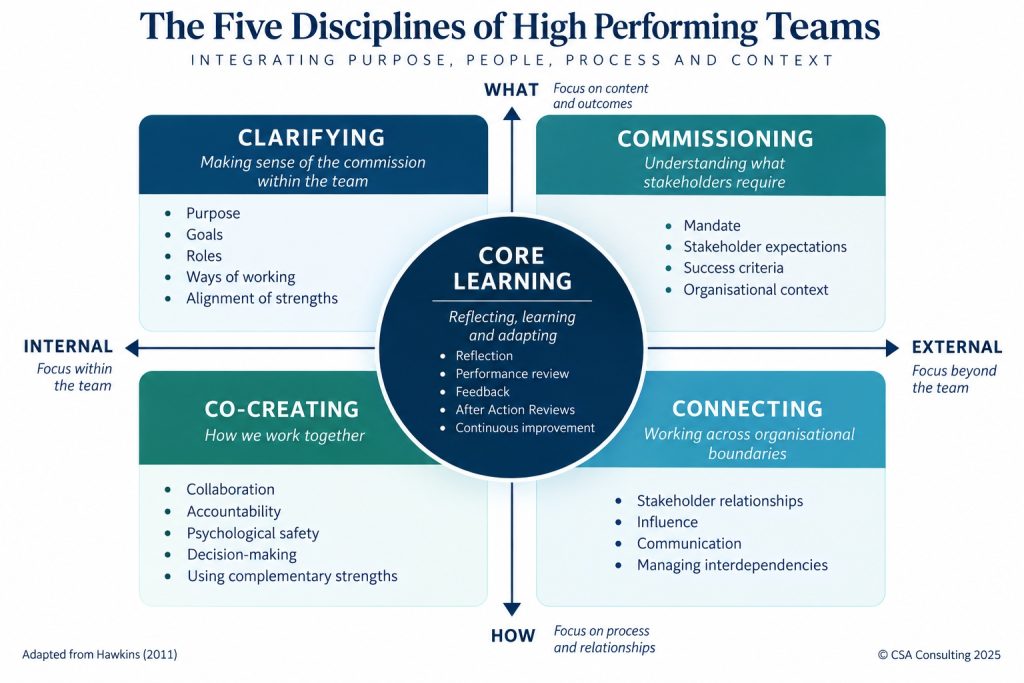
CSA’s Team Process work draws particularly on Peter Hawkins’ Five Disciplines model. The model provides a systemic framework for understanding how leadership teams operate not only internally, but also in relation to the stakeholders and organisational systems around them.
The Five Disciplines
Commissioning: What do our stakeholders require from us and what is our collective purpose?
Clarifying: What must we achieve together that we could not achieve simply by working alongside one another?
Co-creating: How do we work together in ways that are generative and create greater value?
Connecting: How effectively do we engage with and create value for stakeholders beyond the team?
Core Learning: How does the whole team learn, adapt and develop, rather than relying only on individual learning?
The CSA approach to Team Process
We examine how the team makes decisions, manages constructive challenge, holds itself accountable, uses individual and collective strengths, communicates internally and externally, and maintains psychological safety. Particular attention is given to reflexivity: the team’s capacity to step back and examine the process by which it achieves outcomes, rather than focusing only on the task itself. After Action Reviews provide one practical mechanism for turning experience into collective learning.
The Hawkins framework is particularly valuable because it directs attention both inside and outside the team. An executive team can have excellent internal relationships but still fail if it becomes disconnected from customers, employees, the Board or other critical stakeholders. Equally, a team can become highly task-focused while failing to invest sufficiently in reflection and collective learning.
What are the benefits of an Enhanced Team Process?
Effective team processes enable executive teams to convert individual expertise into coordinated collective action. They provide the mechanisms through which members share information, challenge assumptions, make decisions, manage disagreement, learn from experience and engage with stakeholders. Strengthening these processes can help executive teams:
- Improve decision quality by bringing relevant information, expertise and alternative perspectives into discussion before decisions are made.
- Increase coordination and execution by creating greater clarity about priorities, interdependencies, responsibilities and how work moves across functional boundaries.
- Enable constructive challenge by developing the psychological safety and behavioural norms required for executives to question assumptions and disagree productively.
- Reduce unproductive conflict by distinguishing task-related debate from interpersonal and relationship conflict and establishing more effective ways of resolving differences.
- Strengthen collective leadership by enabling expertise and influence to move across the team rather than relying excessively on the CEO or formal hierarchy.
- Increase team reflexivity and learning by systematically reviewing objectives, strategies and performance, developing shared mental models and adapting how the team works.
- Improve stakeholder engagement by helping the executive team operate across its organisational boundaries rather than becoming internally focused.
- Build adaptive capacity by enabling the team to integrate different perspectives and respond collectively to complex strategic challenges, including climate change, biodiversity loss and sustainability transitions.
Effective team process is therefore not primarily about creating a more harmonious team. It is about developing the collective capability to think, decide, learn and act more effectively, particularly when confronting complex and uncertain organisational challenges.